
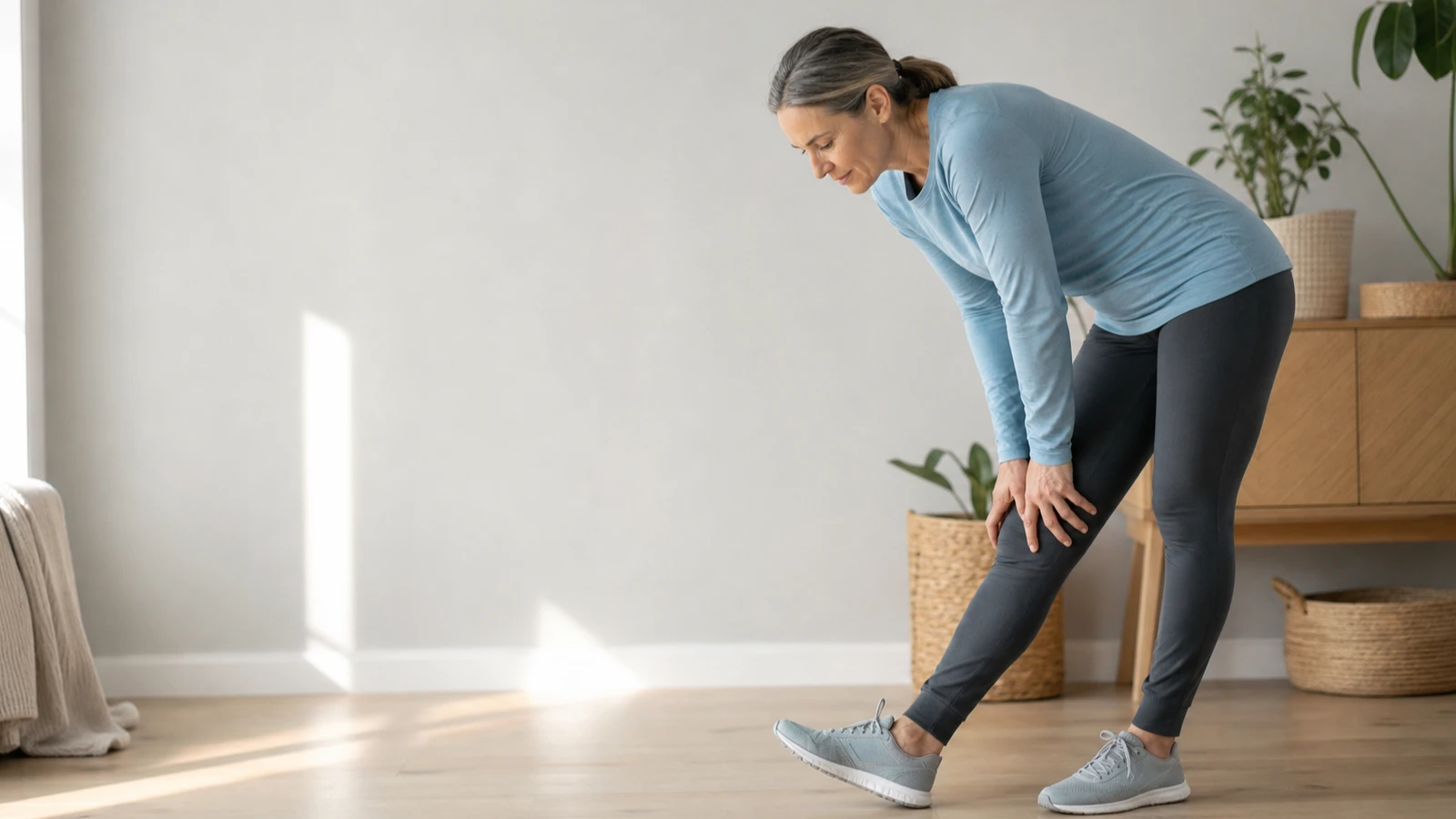
After 40, most people are not chasing the splits. They want to bend down and put their shoes on without a fight, get up off the floor without feeling stiff, walk with confidence, and not feel their joints quietly shrinking their daily life. So stretching and mobility work are not just an athlete’s thing. They are part of moving through your day more comfortably and safely.
The research paints a fairly consistent picture. Stretching improves how far your joints move, eases the mechanical stiffness of the muscle-and-tendon unit, and in older adults may help walking and balance. Just do not oversell it as the whole answer for strength, fall prevention, or your heart.
The Short Version
- Moderate evidence backs stretching for improving range of motion and easing passive stiffness, especially when you do it as an ongoing program.
- In older adults, stretching programs go along with better walking speed and balance compared with people who do not exercise.
- Around 4 minutes of static stretching per muscle group per session looks like enough to get most of the flexibility gains, though the best weekly frequency for older adults is still unclear.
What Stretching Genuinely Helps
The clearest result in this evidence is how far a joint moves, its range of motion. A systematic review and meta-analysis found that stretching programs and resistance training both improve range of motion, with no meaningful difference between the two.
In real life, that means mobility does not come from stretching alone. Resistance training done through a full, appropriate range can also help joints move better. But when the problem is stiffness, feeling stuck, or wanting to work range of motion head-on, stretching is still a tool with evidence behind it.
| Goal | What this evidence found | What it means, without overselling |
|---|---|---|
| Joint range of motion | Stretching and resistance training improved range of motion about equally | Pick based on your situation and what you will stick with |
| Muscle-tendon stiffness | One static stretching session eased passive stiffness | Helps short-term stiffness, but it does not treat a disease |
| Walking and balance in older adults | Stretching programs improved walking speed and balance versus no exercise | Promising, but not a substitute for full training |
Stiffness Can Ease After a Single Session
A systematic review and meta-analysis in older adults found that even one session of static stretching can ease passive stiffness in the muscle-and-tendon unit, and the size of the effect was close to what younger adults get.
Passive stiffness means the mechanical resistance you feel when tissue is stretched, not just whether it feels comfortable. That is part of why some people move more easily right after stretching. Just do not read it as your tendons or joints being “repaired” on the spot.
For anyone 40 and up, the useful point is that stretching may loosen stiffness before you move or before certain activities. This article is not giving you a personal routine, especially if you have pain, an injury, or joint disease. In those cases, check with a qualified health professional before you change what you are doing.
How Much Is Enough
The dose-response analysis here found that around 4 minutes of static stretching per muscle group per session was enough to get range-of-motion gains close to their best.
That number is handy because it pushes back on the idea that longer is always better. But read it with an important caveat: the best weekly frequency, especially for older adults, is still uncertain, and the research protocols varied a lot.
⚠️ Caveat: Do not turn this number into a hard rule for everyone. If you have pain, stiff or restricted joints, an old injury, or a history of balance trouble, start gently and check with a professional when you are unsure.
Walking and Balance in Older Adults
In older adults, ongoing stretching programs noticeably raised walking speed and improved balance compared with people who did not exercise. That counts, because walking speed and balance are tightly bound up with everyday movement and confidence.
Still, do not stretch this into a promise that stretching alone prevents falls, or that it replaces strength work, balance training, and other exercise. The evidence lands at moderate because the protocols were all over the place, and there are still few trials of stretching on its own aimed at keeping people independent.
The fair way to put it: if you barely move right now, a steady stretching program may be one piece of walking and balancing better. It is not the whole answer for rebuilding strength after 40.
The Heart Signal: Interesting, Not Settled
A meta-analysis in middle-aged and older adults found that regular stretching lowered arterial stiffness and resting heart rate, which may be good for the heart and blood vessels.
The catch is that it is still unclear how much of that is specific to stretching versus aerobic exercise or other kinds of movement. Better to call it an interesting signal than proof that stretching can stand in for cardio.
⚠️ Caveat: If you have heart or blood vessel disease, abnormal blood pressure, dizziness, or any medical limits, check with a doctor or qualified professional before changing your activity. Do not treat this article as advice tailored to you.
Stretching or Strength Training: You Do Not Have to Pick a Side
A systematic review and meta-analysis comparing resistance training with stretching found both improved range of motion about the same, with no statistically meaningful gap.
That matters after 40, because good mobility does not have to mean long stretching sessions and nothing else. Resistance training may support range of motion while it builds strength. This evidence does not spell out how to design a strength program, so this article will not invent instructions the data does not give.
A safer way to hold it: stretching is one tool in the box, not the only one. If you enjoy stretching, feel looser for it, and can keep it up, the evidence is on your side. And if you already lift through a good range of motion, you may pick up range-of-motion benefits too.
How Strong the Evidence Is, and How to Use This Article
Overall, the evidence here sits at moderate. Several systematic reviews and meta-analyses support gains in range of motion, passive stiffness, walking speed, and balance, but the protocols varied, and evidence from stretching-only trials aimed at keeping people independent is still not strong enough to call high-confidence.
Use this article to set expectations. Stretching will probably make movement feel easier, ease stiffness, and may help walking and balance in older adults. It is not a promise to fix pain, prevent falls, or replace every other kind of exercise.
This article is for general understanding, not diagnosis or treatment. If you have pain, an old injury, joint disease, heart or blood vessel disease, dizziness, or medical limits, check with a doctor or physical therapist before changing your movement program.
Read next
More in this category
Carpal Tunnel Syndrome: What It Is, What Causes It, and How to Manage It
A short guide to carpal tunnel syndrome, covering what it is, why the thumb, index, and middle fingers go numb especially at night, who is at risk, how a doctor diagnoses it, management from wrist splinting to surgery, and how to start caring for your wrist.
Read article
Chronic Low Back Pain: What It Is, Why the Scan Is Not the Answer, and How to Manage It
A short guide to chronic low back pain, covering what it is, why an X-ray or MRI is often not the answer, which red flags need prompt care, why staying active beats bed rest, and how the ACP guideline puts non-drug care first.
Read article
Knee Osteoarthritis: What It Is, What It Feels Like, and How to Manage It
A short guide to knee osteoarthritis, covering what it is, what it feels like, how it differs from rheumatoid arthritis, what raises the risk, and why movement is the first line of care you build alongside your doctor.
Read articleVerifiable
References for this article
- 1 Effects of stretching exercise on walking performance and balance in older adults: A systematic review and meta-analysis - Salse-Batán et al., Geriatric Nursing (2024, PMID 39733629, DOI 10.1016/j.gerinurse.2024.12.018) pubmed.ncbi.nlm.nih.gov
- 2 Acute effects of static stretching on passive stiffness in older adults: A systematic review and meta-analysis - Nakamura et al., Archives of Gerontology and Geriatrics (2024, PMID 37951029, DOI 10.1016/j.archger.2023.105256) pubmed.ncbi.nlm.nih.gov
- 3 Optimising the Dose of Static Stretching to Improve Flexibility: A Systematic Review, Meta-analysis and Multivariate Meta-regression - Ingram et al., Sports Medicine (2025, PMID 39614059, DOI 10.1007/s40279-024-02143-9) pubmed.ncbi.nlm.nih.gov
- 4 The Efficacy of Stretching Exercises on Arterial Stiffness in Middle-Aged and Older Adults: A Meta-Analysis of Randomized and Non-Randomized Controlled Trials - Kato et al., International Journal of Environmental Research and Public Health (2020, PMID 32764418, DOI 10.3390/ijerph17165643) pubmed.ncbi.nlm.nih.gov
- 5 Strength Training versus Stretching for Improving Range of Motion: A Systematic Review and Meta-Analysis - Afonso et al., Healthcare (2021, PMID 33917036, DOI 10.3390/healthcare9040427) pubmed.ncbi.nlm.nih.gov
Reviewed by Health Coach: A888