
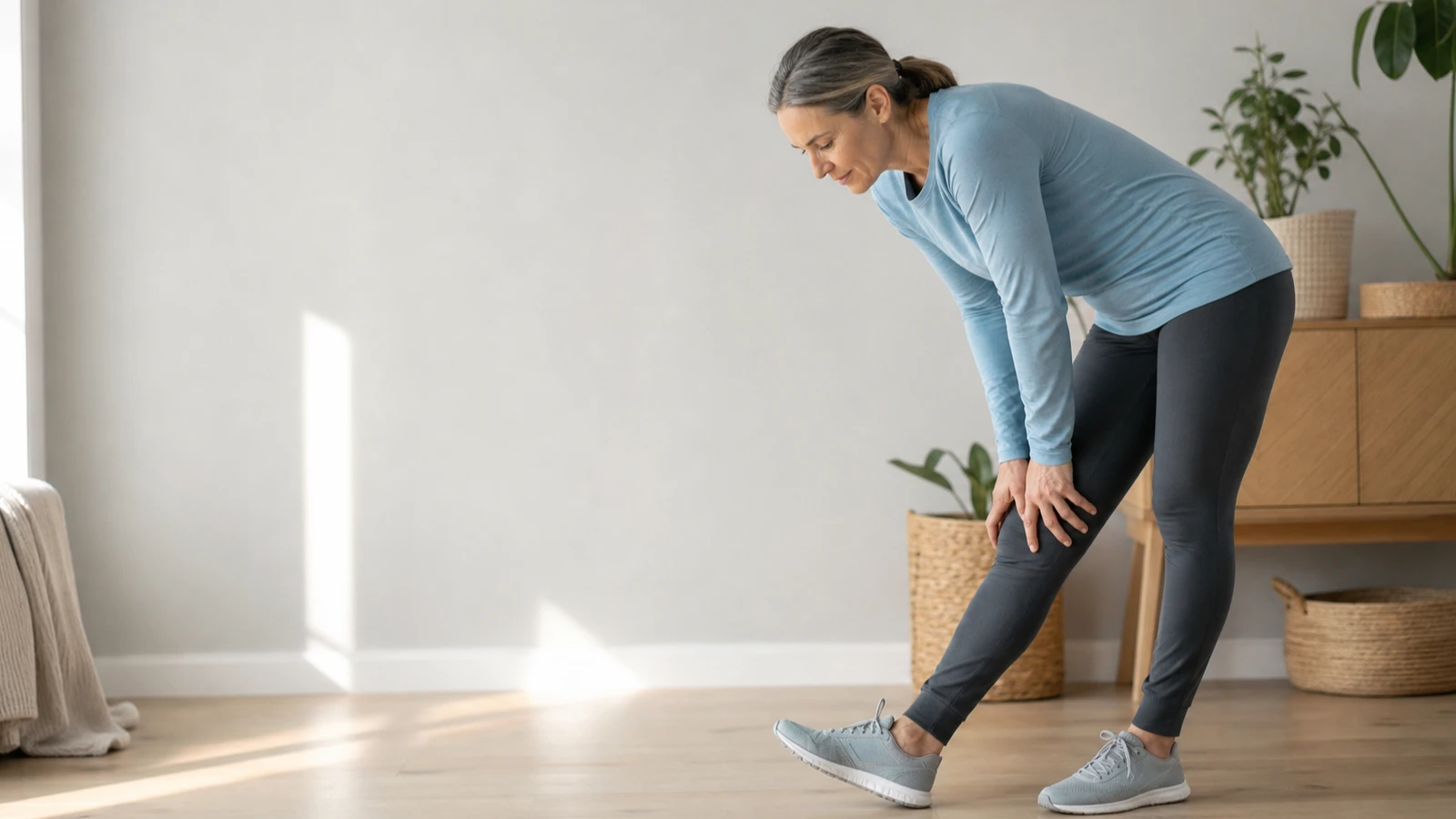
After 40, stretching does not have to be about touching your toes to your forehead. The goal that actually matters is moving your joints better, feeling less stiff, walking with confidence, and making everyday life easier.
The research here supports stretching for improving range of motion, easing passive stiffness, and, in older adults, possibly helping walking speed and balance. But the overall evidence is moderate, not a complete answer for strength or fall prevention.
The Short Version
- Stretching and resistance training improved range of motion about equally, with no statistically meaningful gap.
- A single static stretching session eased muscle-and-tendon passive stiffness in older adults, with effects close to what younger adults get.
- Ongoing stretching programs improved walking speed and balance in older adults compared with no exercise.
It Helps Flexibility and Stiffness
The clearest evidence is for how far a joint moves, its range of motion. A systematic review and meta-analysis found that stretching improves range of motion, and resistance training does about the same.
Static stretching also eased passive stiffness in the muscle-and-tendon unit after just one session in older adults. That is part of why so many people move more easily right after they stretch.
| What you hope for | What this evidence found | How careful to be |
|---|---|---|
| Range of motion | Stretching and resistance training helped about equally | You do not have to pick only one method |
| Passive stiffness | One static stretching session eased it | A stiffness effect, not a disease treatment |
| Walking speed and balance | Stretching programs helped older adults versus no exercise | Not proof that stretching alone prevents falls |
How Much, and What It Does for Walking
The dose-response analysis found that around 4 minutes of static stretching per muscle group per session was enough to get range-of-motion gains close to their best, though the ideal weekly frequency for older adults is still unclear.
In older adults, ongoing stretching programs improved walking speed and balance compared with people who did not exercise. That is a useful real-life signal, but do not read it as stretching alone replacing strength work or balance training.
⚠️ Caveat: If you have pain, an old injury, stiff or restricted joints, or a history of balance trouble, check with a qualified health professional before changing what you do.
The Heart Signal and the Overall Picture
A meta-analysis in middle-aged and older adults found that regular stretching lowered arterial stiffness and resting heart rate, which may be good for the heart and blood vessels.
But it is still unclear how much of that is specific to stretching versus aerobic exercise or other kinds of movement. Stretching should not be sold as a stand-in for cardio.
Overall, the evidence sits at moderate. Several systematic reviews and meta-analyses support gains in range of motion, stiffness, walking speed, and balance, but the protocols varied, and stretching-only evidence for staying independent is still limited.
This summary is for general understanding, not medical advice. If you have heart or blood vessel disease, dizziness, pain, an old injury, joint disease, or medical limits, check with a doctor or physical therapist before changing your movement program. The full version contains the complete rationale and research.
Summary complete
This was the key-points summary
Want to understand why, and the research behind it? Read the full version.
Read the full reasoning and researchRead next
More in this category
Carpal Tunnel Syndrome: What It Is, What Causes It, and How to Manage It
A short guide to carpal tunnel syndrome, covering what it is, why the thumb, index, and middle fingers go numb especially at night, who is at risk, how a doctor diagnoses it, management from wrist splinting to surgery, and how to start caring for your wrist.
Read article
Chronic Low Back Pain: What It Is, Why the Scan Is Not the Answer, and How to Manage It
A short guide to chronic low back pain, covering what it is, why an X-ray or MRI is often not the answer, which red flags need prompt care, why staying active beats bed rest, and how the ACP guideline puts non-drug care first.
Read article
Knee Osteoarthritis: What It Is, What It Feels Like, and How to Manage It
A short guide to knee osteoarthritis, covering what it is, what it feels like, how it differs from rheumatoid arthritis, what raises the risk, and why movement is the first line of care you build alongside your doctor.
Read articleVerifiable
References for this article
- 1 Effects of stretching exercise on walking performance and balance in older adults: A systematic review and meta-analysis - Salse-Batán et al., Geriatric Nursing (2024, PMID 39733629, DOI 10.1016/j.gerinurse.2024.12.018) pubmed.ncbi.nlm.nih.gov
- 2 Acute effects of static stretching on passive stiffness in older adults: A systematic review and meta-analysis - Nakamura et al., Archives of Gerontology and Geriatrics (2024, PMID 37951029, DOI 10.1016/j.archger.2023.105256) pubmed.ncbi.nlm.nih.gov
- 3 Optimising the Dose of Static Stretching to Improve Flexibility: A Systematic Review, Meta-analysis and Multivariate Meta-regression - Ingram et al., Sports Medicine (2025, PMID 39614059, DOI 10.1007/s40279-024-02143-9) pubmed.ncbi.nlm.nih.gov
- 4 The Efficacy of Stretching Exercises on Arterial Stiffness in Middle-Aged and Older Adults: A Meta-Analysis of Randomized and Non-Randomized Controlled Trials - Kato et al., International Journal of Environmental Research and Public Health (2020, PMID 32764418, DOI 10.3390/ijerph17165643) pubmed.ncbi.nlm.nih.gov
- 5 Strength Training versus Stretching for Improving Range of Motion: A Systematic Review and Meta-Analysis - Afonso et al., Healthcare (2021, PMID 33917036, DOI 10.3390/healthcare9040427) pubmed.ncbi.nlm.nih.gov
Reviewed by Health Coach: A888