
Varicose Veins: Why the Veins in Your Legs Bulge, Whether They Are Dangerous, and How to Manage Them
Varicose veins are veins that have become enlarged, twisted, and bulging, usually in the legs, caused by weakened valves that let blood pool. This article explains how they form, their symptoms and risk factors, how they are diagnosed with duplex ultrasound, how they are managed under the 2022 to 2023 guidelines, and how they differ from a deep vein clot, which is a medical emergency.

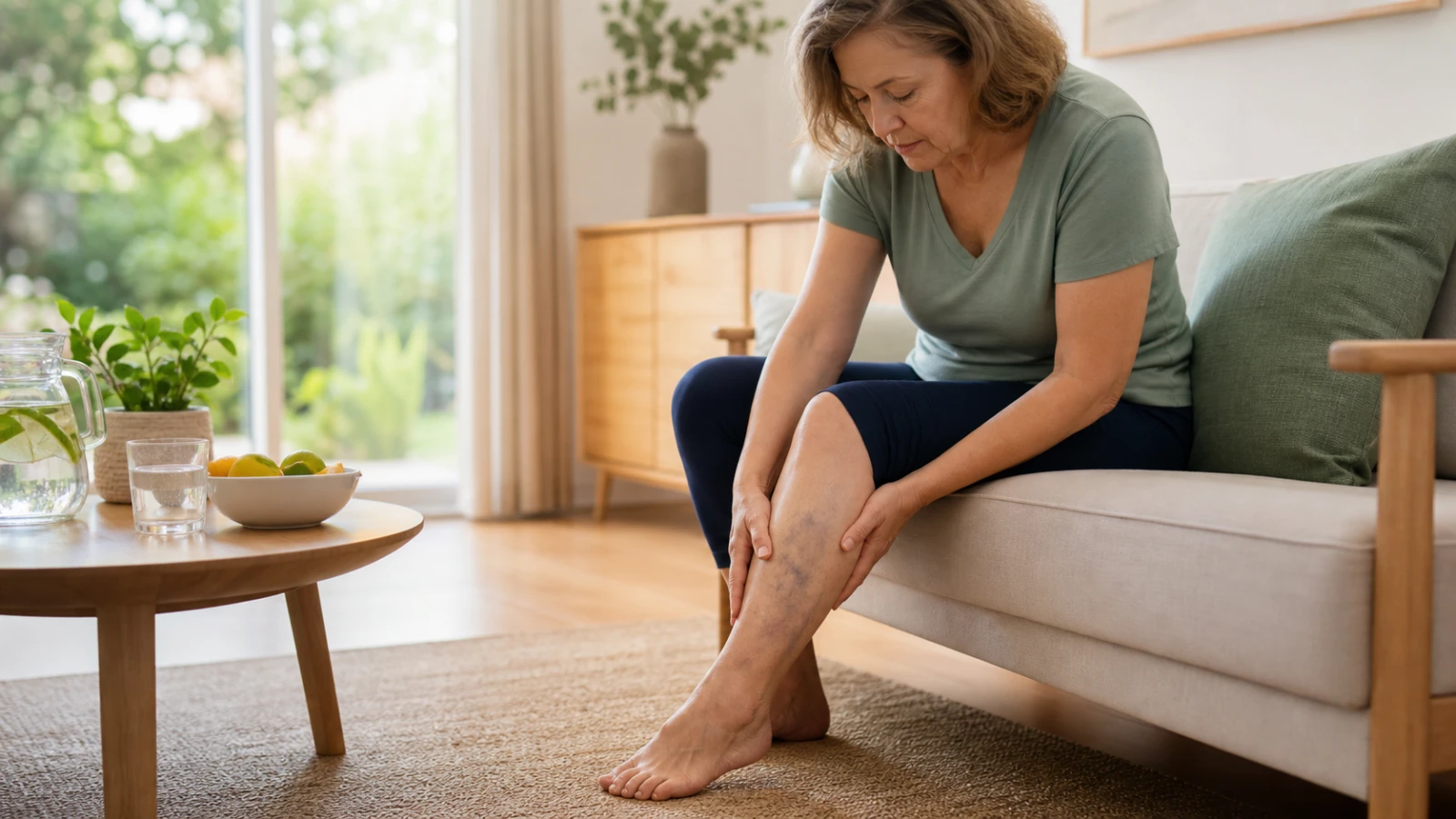
You start to notice greenish or purple veins that bulge and twist across your calf or thigh. Some days your legs feel heavy, tired, or achy, especially after standing or sitting for a long stretch, and they ease up once you put your feet up. Many people worry first about how their legs look, while quietly wondering whether these veins are dangerous and whether they need to do anything about them.
Varicose veins are veins that have become enlarged, twisted, and often bulge up under the skin, most commonly in the legs. This article walks you through it one layer at a time: what causes varicose veins, what symptoms they bring, who is at risk, when they are more than a cosmetic issue, how they are diagnosed and managed, and, importantly, how to tell them apart from a deep vein clot, which is a medical emergency. The reassuring news first: most varicose veins are not dangerous and can be managed, starting with understanding how they form.
Varicose Veins Come from Weakened Valves in the Veins
In the veins of your legs, blood has to travel upward against gravity to return to the heart. To make that possible, nature placed small valves at intervals inside the veins that act like one way doors, opening to let blood move up and closing to stop it from flowing back down. When these valves weaken or become damaged, some blood flows backward and pools in the vein, raising the pressure inside it. Over time the vein wall stretches and widens until it bulges and twists into the varicose vein you can see.
This is part of what is called chronic venous insufficiency, meaning the vein system in the legs can no longer return blood to the heart as efficiently as it should. So varicose veins are not only a surface issue. They are a sign that circulation in your legs is not working at full capacity.
The Symptoms, and When They Are More Than a Cosmetic Issue
Symptoms range from barely noticeable to genuinely disruptive. Common ones include:
- Visible greenish or purple veins that bulge and twist like ropes, usually on the calf or thigh.
- A sense of heaviness, tiredness, or a dull ache in the legs.
- Swelling, especially around the ankles by the end of the day.
- Itching or a burning feeling over the skin near the veins.
- Cramps or restless legs, particularly at night.
A telling feature is that symptoms often worsen after long periods of standing or sitting and improve when you elevate your legs or walk around, because movement helps the calf muscles pump blood back up. That said, plenty of people have few physical symptoms at all, and what bothers them most is the appearance of their legs, which is a perfectly valid reason to see a doctor.
Who Is at Risk
Varicose veins are very common, and several factors raise the odds:
- Older age, as valves and vein walls wear with time.
- Family history, so if a parent or close relative has them, your chances are higher.
- Female sex, partly linked to female hormones.
- Pregnancy, because of the increased blood volume, the pressure of the uterus on veins, and hormones that relax vein walls.
- A job or routine that involves prolonged standing or sitting.
- Higher body weight, which adds pressure on the leg veins.
Having these risk factors does not mean you will definitely develop varicose veins, but it helps explain why some people are more prone than others. Several factors, such as weight and staying active, are within your control.
Complications Worth Knowing About
Most varicose veins are not dangerous, and many people live with them without trouble. But in some cases, especially when chronic venous insufficiency has gone on for a long time without care, complications can develop, such as:
- Skin around the ankle and lower leg changing color, darkening, or developing an eczema like rash.
- Long lasting leg ulcers, particularly near the inner ankle, known as venous ulcers, which heal slowly and need medical care.
- A clot with inflammation in a surface vein, called superficial thrombophlebitis, which makes the vein red, warm, and tender along its length.
These complications do not happen to everyone and usually come on gradually. Noticing changes in the skin or symptoms that are getting worse is a signal to see a doctor for assessment.
How Varicose Veins Are Diagnosed
A doctor diagnoses varicose veins from your history and a physical exam, often asking you to stand so the veins show up more clearly. The main tool for assessing circulation is a duplex ultrasound, a painless test that uses no radiation and shows how the valves are working, where blood is flowing backward, and whether the deep veins are normal. This information matters a great deal for planning treatment, especially if a procedure is being considered, which is why diagnosis should be done by a doctor rather than concluded from images online.
How They Are Managed
Management follows the 2022 to 2023 clinical practice guidelines from Gloviczki and colleagues, which lay out care in steps, with every decision made together with a doctor.
Conservative measures are the foundation for everyone and can be started on your own: moving and walking more so the calf muscles help pump blood, elevating your legs at intervals during the day, managing your weight, and avoiding staying still in one position for long stretches.
Compression stockings are medical stockings that squeeze more firmly at the ankle and less further up, helping push blood back up and easing swelling and heavy, aching legs. A doctor may recommend them for some people, choosing the level of compression to suit the individual.
Medical procedures are for people with bothersome symptoms or complications. The 2022 to 2023 guidelines often recommend endovenous thermal ablation, which seals the problem vein from the inside using heat, as a first choice for a main faulty vein. There is also sclerotherapy, injecting a substance to close the vein, and surgery in certain cases. The choice depends on the location, size, and ultrasound findings, as well as each person’s goals, so it must be decided with a specialist. This article does not give doses or treatment recipes, because those are specific to the individual.
A point of caution: most varicose veins are harmless, but not every case should be ignored, and they must be told apart from a deep vein clot.
Varicose veins are usually a cosmetic concern and not dangerous, but they can sometimes reflect underlying chronic venous disease, and in some people they lead to skin changes, ulcers, or clots, so symptoms that persist or skin that is starting to change deserve assessment. Just as important, a leg that suddenly becomes painful, swollen, and warm on one side is a different matter and could be a deep vein thrombosis, a clot in the deep veins that is a medical emergency needing prompt care. Do not assume it is simply a varicose vein. Sources: 2022 to 2023 clinical practice guidelines (PMID 36326210), StatPearls.
Varicose Veins Are Not a Deep Vein Clot
One condition must be clearly separated from varicose veins: deep vein thrombosis, or DVT, a clot that forms in the deep veins of the leg. Varicose veins are a chronic, gradual condition that is usually not an emergency. DVT tends to come on suddenly, with one leg becoming painful, swollen, warm, and sometimes red over a short time. DVT is a medical emergency, because the clot can break loose and travel to the lungs. So if one leg suddenly becomes swollen, painful, and warm, do not assume it is just a varicose vein. See a doctor promptly.
When to See a Doctor, and How to Start Caring for Yourself
See a doctor if you notice these signs:
- Leg pain, heaviness, or swelling that increasingly interferes with daily life.
- Skin on the leg or ankle changing color, darkening, hardening, or developing an itchy rash.
- A wound on the leg that heals slowly or not at all.
- Bleeding from a vein, or a red, warm, tender lump along a vein.
- One leg suddenly becoming painful, swollen, and warm, which should prompt immediate medical attention because it could be a deep vein clot.
In the meantime, there is a lot you can start doing for yourself: move and walk regularly, avoid standing or sitting still for long, and if you must sit for a while, get up to move or flex your ankles periodically. Elevate your legs above heart level at intervals when you can, exercise your calf muscles by walking or rising onto your toes, keep your weight in a healthy range, and consider compression stockings if your doctor advises them. These small habits can ease symptoms and slow the condition without waiting until a procedure is needed.
Deciding on a procedure, such as thermal ablation, sclerotherapy, or surgery, is something to assess and decide together with a doctor, based on your symptoms, ultrasound findings, and goals. It is not something to decide on your own from general information.
This content is general information for health care, not advice that replaces seeing a doctor. Diagnosing and managing varicose veins, including any decision about a procedure or treatment, should always be done together with a human doctor or specialist.

Read next
More in this category

Weight Management and Obesity: A Short Guide to Regain, Behaviors, and Looking Beyond BMI
A short guide to weight management and obesity, covering why weight regain is common at the population level and not a personal failure, why to look beyond BMI to waist and body composition, which sustainable behaviors are linked to long term maintenance, who should be careful, when to see a doctor, and how to start, treating every number as population level knowledge rather than a personal target.
Read article
BPPV Vertigo: What It Is, How It Is Diagnosed, and How to Manage It
A short guide to BPPV, benign paroxysmal positional vertigo, the most common cause of vertigo. It covers what BPPV is, why a head movement can make the room spin, what the symptoms look like, how it is diagnosed and managed with clinician guided repositioning maneuvers, and the warning signs that call for urgent care.
Read article
Cataracts: What They Are, How to Spot Them, and How They Are Treated
A short guide to cataracts, covering what a cataract is, how to spot the symptoms, what raises the risk, how it is diagnosed, and why surgery is the only proven treatment, decided together with an eye doctor.
Read articleVerifiable
References for this article
- 1 Gloviczki P et al. The 2022 Society for Vascular Surgery, American Venous Forum, and American Vein and Lymphatic Society clinical practice guidelines for varicose veins (J Vasc Surg Venous Lymphat Disord 2023, PMID 36326210) pubmed.ncbi.nlm.nih.gov
- 2 StatPearls (NCBI Bookshelf NBK470194): Varicose Veins ncbi.nlm.nih.gov
Reviewed by Health Coach: A888