
Obstructive Sleep Apnea After 40: More Than Snoring, and Why the Heart Matters
Obstructive sleep apnea is linked with cardiovascular risk and all-cause mortality, CPAP outcomes depend on adherence, and Thai data still need careful interpretation
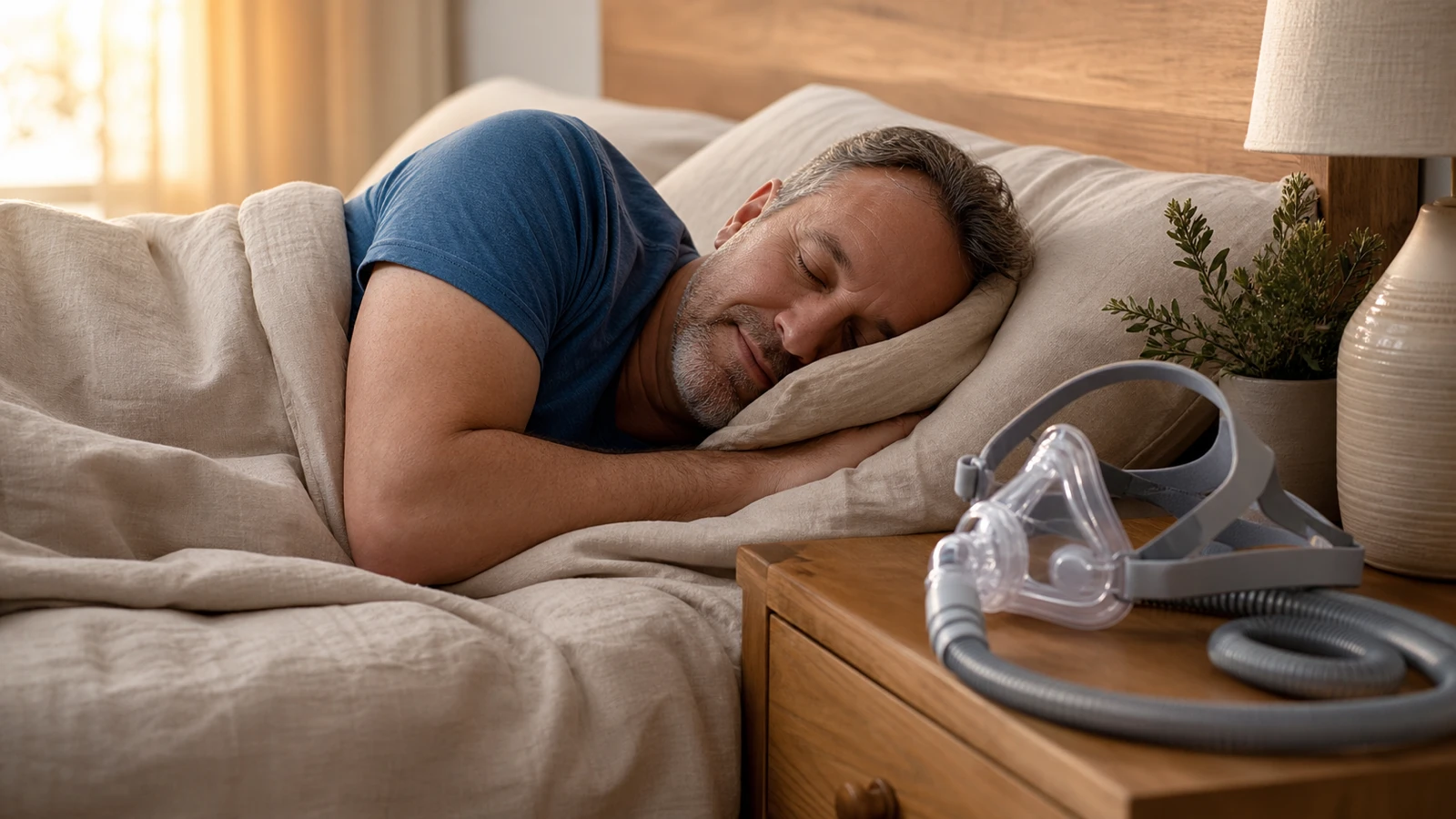
Most people meet this the same small way. Someone beside you says, “you snored so loudly last night,” or “it looked like you stopped breathing for a second.” You shrug it off as noise. But the research here says obstructive sleep apnea, or OSA, the condition where the upper airway narrows or blocks over and over during sleep, should not be shrunk down to a snoring joke, above all past 40, when the heart, the blood vessels, and long-term strength start to matter more.
The heart of it is that OSA still slips past diagnosis in a lot of people. The reasons stack up: testing is hard to reach, screening is patchy, and everyday symptoms like snoring and daytime tiredness get waved off as normal.
Three-Line Summary
- OSA goes along with a rise in new cardiovascular events and death from any cause, and that rise tracks with how severe the OSA is.
- When trials are analyzed by the group people were assigned to, the cardiovascular results come out neutral, but using CPAP steadily for at least 4 hours a night goes along with fewer repeat major heart and brain events.
- The evidence for the drug tirzepatide is promising in people with moderate-to-severe OSA plus obesity, but it should not be stretched to people who are not obese.
1. OSA Is Not Just Snoring
This research says OSA is still diagnosed less often than it truly occurs, both in the general population and among heart patients. There is no single cause. The barriers include how hard testing can be to reach, screening that does not cover everyone, and how little attention symptoms like snoring and daytime tiredness tend to get.
If you are past 40, the line to hold on to is that snoring is not always a joke or a nuisance for the person next to you. When snoring comes with daytime tiredness, or when the heart is already a worry, it is entirely reasonable to talk with a doctor about getting properly checked.
⚠️ Caveat: This research does not hand you diagnostic criteria, a full symptom list, or a self-test. Do not use this article in place of a real clinical assessment.
2. Heart Risk and Death: Strong Evidence, Read It Precisely
A 2025 systematic review and meta-analysis of prospective cohort studies, the ones that follow people forward and watch what happens, concluded that OSA is independently linked to a higher risk of new cardiovascular events and death from any cause, with the risk climbing as OSA grows more severe.
The exact words carry weight here: “independently linked” and “climbing with severity.” That is not the same as saying every snore equals heart disease, and it does not hand you a diagnosis off one symptom.
In real life it means this: if you already carry cardiovascular risk or disease, and there are signs pointing toward OSA, sitting down with a doctor about a sleep assessment is not a small thing to shrug off.
3. CPAP: The Result Depends on Actually Using It
The CPAP evidence needs a slow read, because two findings look like they clash but actually keep us honest.
The first: when trials are analyzed by the group people were assigned to, the cardiovascular results come out neutral. Read strictly by assignment, the numbers do not clearly show that everyone told to use CPAP gains a heart benefit.
The second: a 2023 JAMA meta-analysis found that using CPAP for at least 4 hours a night went along with a real drop in repeat major heart and brain events.
So the message is not “CPAP definitely stops heart events for everyone.” It is that once a clinician has decided CPAP is right for you, actually using it, night after night, is where the benefit lives. If you are on CPAP and struggling with it, do not stop or tinker on your own. Talk to your medical team or a sleep specialist.
4. The Thai Picture: Risk Signals Are There, but the Population Data Is Thin
The research notes that standard screening questionnaires turn up high, unrecognized OSA risk in certain Thai patient groups. The example in the reference list is Thai people with psoriasis, who showed a high risk of OSA.
The limit to keep in view is that this kind of evidence is about screening risk in a specific patient group, not the diagnosed rate of OSA across the whole Thai population. The research itself says large-scale data on diagnosed OSA in the general Thai population is still limited.
If you are Thai, the takeaway is that these risk signals and screening deserve more attention, but you cannot take numbers from one specific group and let them stand in for everyone in Thailand.
5. Tirzepatide: Useful for a Specific Group, Not a General Answer
A 2024 New England Journal of Medicine trial in the reference list found that tirzepatide, a dual GIP/GLP-1 receptor agonist (a drug that acts on two metabolic hormone receptors, GIP and GLP-1), lowered sleep apnea severity and improved cardiovascular risk factors in people with moderate-to-severe OSA plus obesity.
This is important evidence, and its edges matter just as much. The research says plainly that how well it works, and how safe it is, in people who are not obese remains unclear.
⚠️ Caveat: Tirzepatide is a medication, not a sleep plan you start on your own. If you have OSA, obesity, or other conditions, see a doctor to weigh the benefits, the risks, and whether it fits you.
6. Read the Evidence Without Overclaiming
| Issue | What the research says | How confident you can be |
|---|---|---|
| OSA, heart events, and death | Independently linked, with risk rising as OSA grows more severe | Strong |
| CPAP in trials | Results by assigned group come out neutral | Needs a careful read |
| CPAP when used steadily | At least 4 hours a night goes along with fewer repeat heart and brain events | Moderate to strong |
| Underdiagnosis | Seen in the general population and among heart patients | Strong overall |
| Thai data | High risk shows up in some Thai patient groups on questionnaires, but general-population data is limited | Limited to moderate |
| Tirzepatide | Lowers OSA severity and improves heart risk factors in people with moderate-to-severe OSA plus obesity | Strong in the studied group, limited outside it |
On the whole the evidence is strong for the link between OSA, heart outcomes, and death from any cause, and for the point that OSA goes underdiagnosed. Treatment claims need a lighter touch: CPAP hinges on really using it, and the tirzepatide evidence applies to people with obesity in the group that was studied.
If you snore, feel worn out during the day, have heart disease or heart risk, or someone close to you frets about your breathing at night, talk with a doctor or sleep specialist about getting properly checked. This article is here to help you understand, not to diagnose you or hand out personal treatment.

Read next
More in this category

Napping: A Short Guide to Experimental Benefits, Long or Frequent Napping, and When to Seek Evaluation
A short guide to experimental evidence for short-term alertness and memory benefits, why sleep inertia varies, why cardiovascular and mortality associations do not establish cause, and when increasing or excessive daytime sleepiness warrants broad evaluation.
Read article
Sleep, Metabolism, and Weight: Short-Term Insulin Sensitivity Evidence and Long-Term Weight Associations
A short guide distinguishing experimental evidence that sleep restriction can reduce insulin sensitivity in the short term from long-term observational associations with weight and metabolic risk, with study limitations, symptoms that warrant evaluation, and medication and sleep-aid safety boundaries.
Read article
Restless Legs Syndrome: What It Is, How to Recognize It, and How to Manage It
A short guide to Restless Legs Syndrome, also called Willis-Ekbom disease, covering what it is, the four hallmark features that help you recognize it, why it happens, how iron fits in, and how it is diagnosed and managed with your doctor.
Read articleVerifiable
References for this article
- 1 Association Between Obstructive Sleep Apnea and Cardiovascular Risk: A Systematic Review and Meta-Analysis of Prospective Cohort Studies - Craciun et al., Medicina (2025, PMID 41303825) pubmed.ncbi.nlm.nih.gov
- 2 Adherence to CPAP Treatment and the Risk of Recurrent Cardiovascular Events: A Meta-Analysis - Sánchez-de-la-Torre et al., JAMA (2023, PMID 37787793) pubmed.ncbi.nlm.nih.gov
- 3 Overcoming an underdiagnosed respiratory condition: should more patients with cardiovascular complications be screened for obstructive sleep apnea? - Romarheim et al., Expert Review of Cardiovascular Therapy (2025, PMID 40853037) pubmed.ncbi.nlm.nih.gov
- 4 Tirzepatide for the Treatment of Obstructive Sleep Apnea and Obesity - Malhotra et al., New England Journal of Medicine (2024, PMID 38912654) pubmed.ncbi.nlm.nih.gov
- 5 The prevalence of high risk of obstructive sleep apnea in patients with psoriasis - Supajarupan et al., Sleep and Breathing (2025, PMID 40232659) pubmed.ncbi.nlm.nih.gov
Reviewed by Health Coach: A888