
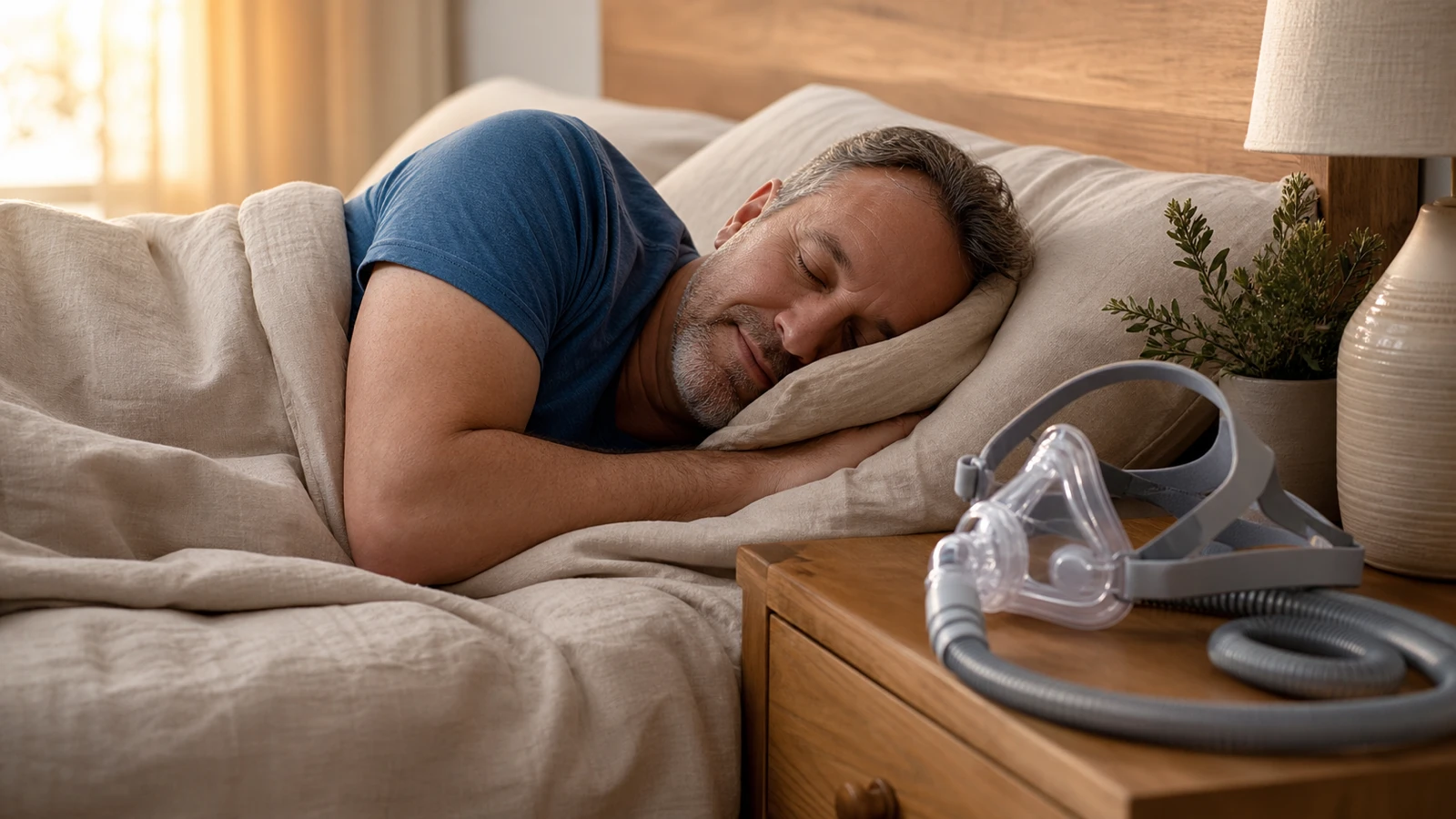
Picture the night someone next to you says, “you snored so loudly.” You laugh it off as a bit of noise, or figure you were just exhausted and sleeping deep.
Then the next morning you wake up as if the battery never charged, even after hours in bed. You are drowsy by midday, your focus slips, and once you hit 40 you cannot help wondering whether any of this touches your heart.
Obstructive sleep apnea should not be filed away as nighttime noise. The research here concludes that it goes along with cardiovascular events and death from any cause, and that it still slips past diagnosis in a lot of people.
The task is to read the evidence in proportion. The risk is real, but the claims about treatment and medication should not run past what the studies actually show.
Three-Line Summary
- OSA goes along with cardiovascular events and death from any cause, and the risk rises as it grows more severe.
- CPAP does not show a heart benefit for everyone in every analysis, but really using it, at least 4 hours a night, goes along with better outcomes.
- Thai data shows risk signals in some groups, but the diagnosed rate of OSA across the general Thai population is still limited.
1. Do Not Write It Off as Just Snoring
A common mistake is to treat snoring as nothing more than an annoying noise. The research asks you not to set this aside like an old fan that is merely loud and then forgotten.
It says OSA is still diagnosed less often than it truly occurs, both in the general population and among heart patients. The reasons include how hard testing is to reach, screening that misses people, and how little attention symptoms like snoring and daytime tiredness tend to get.
If you snore, feel worn out during the day, or worry about your heart, do not lean on this article or on guesswork for a diagnosis. Talk with a doctor about getting checked.
2. The Heart Risk Is Real, but Do Not Overstate It
A 2025 systematic review and meta-analysis of prospective cohort studies concluded that OSA is independently linked to new cardiovascular events and death from any cause, with the risk climbing as OSA grows more severe.
The right word is “linked.” That is not the same as saying every snore is heart disease, and it does not let anyone settle a diagnosis off one symptom.
Think of a snore as a warning light on the dashboard. Sometimes it is minor, sometimes it means lift the hood and let a mechanic look, especially when heart risk is already in the picture.
3. CPAP Only Makes Sense Read With Real Use
When trials are analyzed by the group people were assigned to, the cardiovascular results come out neutral. But a 2023 meta-analysis found that people who used CPAP for at least 4 hours a night had a real drop in repeat major heart and brain events.
The balanced read is this: once a clinician has decided CPAP is right for you, using it steadily is what matters. If you are wrestling with it, talk to your medical team or a sleep specialist rather than stopping or changing it on your own.
4. Tirzepatide and Thai Data: Hopeful, but Bounded
A 2024 New England Journal of Medicine trial found that tirzepatide lowered sleep apnea severity and improved cardiovascular risk factors in people with moderate-to-severe OSA plus obesity. How well it works, and how safe it is, in people who are not obese remains unclear.
In Thailand, standard screening questionnaires show high OSA risk in some patient groups, such as people with psoriasis. That is not the same as the diagnosed rate of OSA across the whole Thai population.
⚠️ Caveat: Tirzepatide is a medication and should be weighed with a doctor. This article is here to help you understand, not to tell you to start a medication on your own.
5. Match the Claim to the Strength of the Evidence
| Issue | Evidence summary | Confidence |
|---|---|---|
| OSA, heart events, and death | Independently linked, with risk rising by severity | Strong |
| CPAP in trials | Results by assigned group come out neutral | Needs a careful read |
| CPAP when used steadily | At least 4 hours a night goes along with fewer repeat events | Moderate to strong |
| Thai data | Risk signals show up in some groups, but general-population data is limited | Limited to moderate |
| tirzepatide | Works in the studied group with moderate-to-severe OSA plus obesity | Strong only within the studied group |
On the whole the evidence is strong enough to treat OSA as something worth a proper look, though the treatment claims still call for restraint. The small step for tomorrow is simple: if you or someone you love snores, feels worn out by day, or worries about the heart, do not let it stay a joke at the dinner table. Set aside time to talk with a doctor, and a snore that used to get overlooked becomes a signal that finally gets the care it deserves.
This summary is here to help you understand, not to diagnose you or hand out personal treatment. The full version lays out the complete reasoning and research.

Summary complete
This was the key-points summary
Want to understand why, and the research behind it? Read the full version.
Read the full reasoning and researchRead next
More in this category

Napping: A Short Guide to Experimental Benefits, Long or Frequent Napping, and When to Seek Evaluation
A short guide to experimental evidence for short-term alertness and memory benefits, why sleep inertia varies, why cardiovascular and mortality associations do not establish cause, and when increasing or excessive daytime sleepiness warrants broad evaluation.
Read article
Sleep, Metabolism, and Weight: Short-Term Insulin Sensitivity Evidence and Long-Term Weight Associations
A short guide distinguishing experimental evidence that sleep restriction can reduce insulin sensitivity in the short term from long-term observational associations with weight and metabolic risk, with study limitations, symptoms that warrant evaluation, and medication and sleep-aid safety boundaries.
Read article
Restless Legs Syndrome: What It Is, How to Recognize It, and How to Manage It
A short guide to Restless Legs Syndrome, also called Willis-Ekbom disease, covering what it is, the four hallmark features that help you recognize it, why it happens, how iron fits in, and how it is diagnosed and managed with your doctor.
Read articleVerifiable
References for this article
- 1 Association Between Obstructive Sleep Apnea and Cardiovascular Risk: A Systematic Review and Meta-Analysis of Prospective Cohort Studies - Craciun et al., Medicina (2025, PMID 41303825) pubmed.ncbi.nlm.nih.gov
- 2 Adherence to CPAP Treatment and the Risk of Recurrent Cardiovascular Events: A Meta-Analysis - Sánchez-de-la-Torre et al., JAMA (2023, PMID 37787793) pubmed.ncbi.nlm.nih.gov
- 3 Overcoming an underdiagnosed respiratory condition: should more patients with cardiovascular complications be screened for obstructive sleep apnea? - Romarheim et al., Expert Review of Cardiovascular Therapy (2025, PMID 40853037) pubmed.ncbi.nlm.nih.gov
- 4 Tirzepatide for the Treatment of Obstructive Sleep Apnea and Obesity - Malhotra et al., New England Journal of Medicine (2024, PMID 38912654) pubmed.ncbi.nlm.nih.gov
- 5 The prevalence of high risk of obstructive sleep apnea in patients with psoriasis - Supajarupan et al., Sleep and Breathing (2025, PMID 40232659) pubmed.ncbi.nlm.nih.gov
Reviewed by Health Coach: A888