
Sauna and Cold Exposure: How Much Thermal Hormesis Helps You Live Longer, and Separating Strong Evidence from Hype
Follow-up studies of Finnish men found that those who used the sauna 4 to 7 times a week had lower risks of cardiac death and dementia than those who used it once a week, but most of the evidence is observational, not causal; cold exposure genuinely raises dopamine and eases soreness, yet it blunts muscle building after weight training and carries an overlooked drowning risk
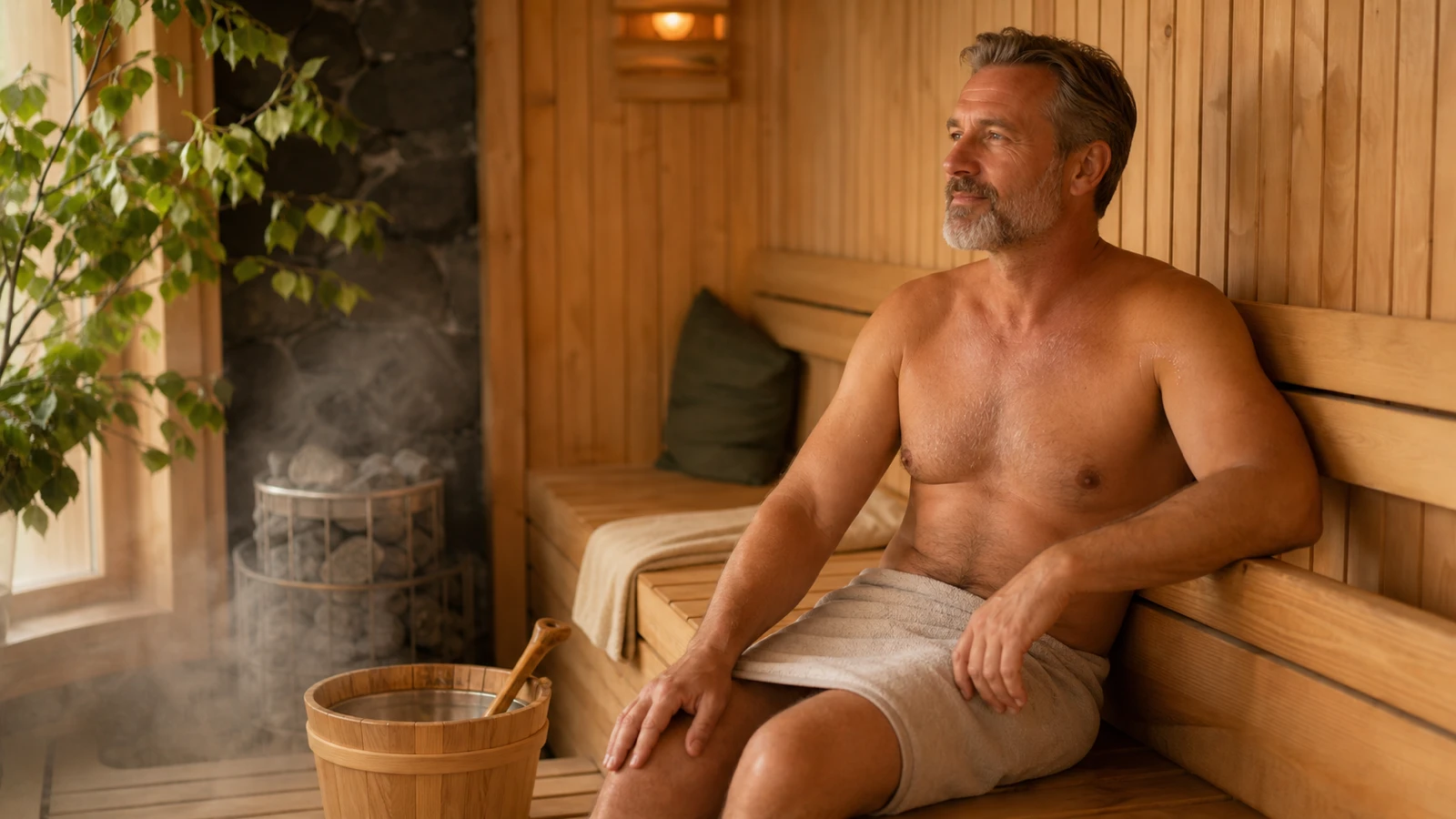
Does frequent sauna use really help you live longer? And what about the cold plunge that everyone is trying right now? Many people over 40 become interested in both at once, after seeing posts claiming they help the heart, the brain, and aging.
The truth is that these two topics sit on different tiers of evidence. The sauna has long-term follow-up studies running up to 20 years, while cold exposure has short mechanistic studies that are clear only in certain areas. This article separates what is trustworthy from what is still overstated.
Hormesis is the principle that mild, intermittent stress, such as heat or cold, prompts the body to adapt and grow stronger, much as exercise is a stress that makes the body fitter.
A Three-Line Summary
- Finnish men who used the sauna 4 to 7 times a week had a roughly 63 percent lower risk of sudden cardiac death than those who used it once a week, and a roughly 66 percent lower risk of dementia, but the figures come from observation and do not prove the sauna is the cause.
- Cold exposure raises dopamine and norepinephrine in a sustained spike lasting several hours, genuinely helping mood and alertness, and it reduces muscle soreness after exercise.
- Cold water immersion right after weight training blunts muscle building, the claim that cold plunging clearly burns fat is overstated, and there is an overlooked drowning risk from cold shock.
Topic 1: Sauna, Mortality, and Heart Disease
The core study is the Kuopio Ischemic Heart Disease study, or KIHD, published in JAMA Internal Medicine in 2015. It followed 2,315 middle-aged Finnish men, aged 42 to 60, for a median of 20.7 years. The result was a more-is-better pattern, compared with people who bathed once a week.
| Sauna frequency | Sudden cardiac death | All-cause death, cumulative 20 years |
|---|---|---|
| 1 time per week (reference) | 1.00 | 49.1% |
| 2 to 3 times per week | lower | 37.8% |
| 4 to 7 times per week | HR 0.37 (95% CI 0.18 to 0.75) | 30.8% |
The most frequent group therefore had a roughly 63 percent lower risk of sudden cardiac death. A 2018 study expanded to include women and found that the risk of cardiac death in the group bathing 4 to 7 times a week was lower than the once-a-week group, HR 0.23 (95% CI 0.08 to 0.65).
Why This Number Needs Caution
The 2015 and 2018 studies came from the same research group and the same population base, KIHD in eastern Finland, so they are not yet a full confirmation from two independent sources. The sauna-mortality claim therefore sits in the tier of strong evidence still awaiting confirmation from another population.
On top of that, all of it is observational cohort data, which shows association, not cause. People who use the sauna often in Finland may be wealthier, exercise more, or have more free time. These variables can lower the risk of death on their own, unrelated to the sauna, and even after the researchers adjusted for the main risk factors, the confounding is not fully removed.
⚠️ caveat: the effect size of the sauna in observational work, a roughly 40 percent reduction in mortality and a roughly 65 percent reduction in dementia, is large enough to be suspicious, about four times the effect of statins, which is a red flag for residual confounding, and there is still no RCT proving the sauna actually extends life.
Topic 2: Sauna, Dementia, and the Mechanisms That Can Explain It
A 2017 study in Age and Ageing used the same KIHD cohort and found that the most frequent group had clearly lower risk of dementia and Alzheimer’s disease.
| Sauna frequency | Dementia (HR) | Alzheimer’s (HR) |
|---|---|---|
| 1 time per week | 1.00 | 1.00 |
| 2 to 3 times per week | 0.78 (0.57 to 1.06) | 0.80 (0.53 to 1.20) |
| 4 to 7 times per week | 0.34 (0.16 to 0.71) | 0.35 (0.14 to 0.90) |
Dementia differs from mortality in that an independent cohort confirms it. A 2020 Finnish Mobile Clinic study followed 13,994 men and women for up to 39 years, found 1,805 dementia cases, and the frequent group had a lower dementia risk, HR 0.47 (0.25 to 0.88) over the first 20 years. This research team is a different group and a different cohort from KIHD, so it counts as a genuinely independent source that reproduces the same signal.
The remaining limitation is that both studies are Finnish populations, which share the same sauna culture and may have shared confounding, and the effect in the 2020 study weakened over longer follow-up, to HR 0.81 across the full period. All of it is still observational, not causal.
The Mechanisms with Some Evidence
Heat triggers heat shock proteins (HSP70, HSP90), which help fold other proteins correctly and reduce inflammation. About 20 minutes in a sauna at 80 to 100 degrees Celsius can trigger HSP.
The effect on the heart resembles light to moderate exercise. Heart rate rises to roughly 120 to 150 beats per minute during bathing, and blood pressure drops briefly afterward from vasodilation. With regular repetition, plasma volume increases, similar to the effect of aerobic training.
As for the claim that the sauna immediately improves how blood vessel walls work (flow-mediated dilation), the evidence conflicts. Older work said it improved, but newer RCTs in healthy people and in coronary patients found no acute effect, so this remains unsettled.
Topic 3: What Cold Exposure Really Helps, and What It Damages
Dopamine and Mood: A Real and Lasting Spike
A 2000 study in the European Journal of Applied Physiology had people immerse in 14 degree Celsius water for 1 hour and found dopamine rose by roughly 250 percent and norepinephrine by roughly 530 percent, with no significant rise in cortisol.
The interesting part is that this dopamine response lasts several hours and is associated with improved mood and motivation. Unlike dopamine-stimulating drugs, where the body downregulates the response with repeated use, cold immersion keeps triggering it even with regular practice.
Cold After Weight Training Blunts Muscle
This is the strongest evidence on the cold side, because two independent RCTs confirm it.
A 2015 study in The Journal of Physiology had 16 weight-training men train for 7 weeks, then immerse in 10 degree water for 15 minutes after training, compared with active recovery. Type II muscle growth was suppressed in the cold group, while strength (1-RM) increased equally in both groups. The mechanism is that cold reduces p70S6K activity in the mTOR pathway that signals protein synthesis.
A 2019 study in 16 men over 12 weeks confirmed the same result. The control group gained roughly 15 percent muscle mass, the cold group roughly 2 percent, with no difference in strength.
If your goal is building muscle, avoid cold water immersion right after weight training. If the goal is reducing soreness and recovery, and strength is not the main issue, cold immersion is acceptable.
What Is Overstated
The claim that cold plunging clearly burns fat is overstated. Cold raises the acute metabolic rate a little and only briefly, not enough to reduce fat meaningfully in real life.
The claim that cold reduces whole-body inflammation is also weak. Most work finds that cold reduces local markers of muscle damage (CK) and soreness (DOMS), but does not clearly reduce whole-body inflammatory markers (IL-6, TNF-alpha, CRP).
Points to Watch
The cold shock response can drown strong swimmers Suddenly entering water colder than 15 degrees triggers an uncontrollable gasp reflex in the first 3 to 5 minutes. Water safety data note that many cold-water drowning victims are strong swimmers, because this reflex overrides conscious control. Regular practice can reduce the panic somewhat, but the physiological reflex remains. Do not go in alone, and start with milder cold and shorter durations.
Sauna detox or heavy-metal removal is an overstated claim Sweat does contain small amounts of heavy metals, but the amount excreted per session is too small to matter clinically. The liver and kidneys are already the body’s main detox system, and the sauna does not replace them.
Contraindications and at-risk groups Pregnant women should avoid the sauna, especially in the first trimester, because a core temperature above 39 degrees Celsius is associated with neural tube defects in the fetus, per ACOG guidance. People with uncontrolled high blood pressure, a recent heart attack, or acute arrhythmia should also avoid it. And do not drink alcohol before or during a sauna, because it raises the risk of blood pressure drops and arrhythmia. If you have heart disease or high blood pressure, consult a doctor before starting.
The Thai Context
People who live in a hot country are already partly heat-adapted, with greater plasma volume and better sweating. The sauna effects from the Finnish studies were measured in a population that lives in a cold country and is not heat-adapted, so it is not yet clear how far the same dose-response applies to Thai people.
On the cold side, people in a hot country have no cold adaptation at all, so the cold shock risk is higher than for people in cold countries. If you want to try it, go gradually and have someone with you.
What We Still Do Not Know
- The evidence that the sauna reduces mortality awaits confirmation from an independent cohort outside Finland before it can move up to fully established knowledge.
- There is still no RCT proving the sauna actually extends life, because a long-term RCT on this is hard to run, and all of it is association.
- Contrast therapy of alternating hot and cold has small studies suggesting it reduces swelling after injury, but there is no evidence for the heart or for longevity.
- The dose and frequency of cold that suits ordinary people, not athletes, has no clear conclusion yet.
A Small Step You Can Take
If you want to try the sauna and do not have uncontrolled heart disease or high blood pressure, start with short sessions, drink enough water, and do not combine it with alcohol. If you want to try cold exposure for mood and recovery, start with milder cold and shorter durations, and always have someone with you. And if your goal is building muscle, avoid cold immersion right after weight training. Set your expectations by the real evidence: the sauna and cold exposure are interesting supplementary tools, not a magic cure that guarantees a longer life.
Read next
More in this category

Weight Management and Obesity: A Short Guide to Regain, Behaviors, and Looking Beyond BMI
A short guide to weight management and obesity, covering why weight regain is common at the population level and not a personal failure, why to look beyond BMI to waist and body composition, which sustainable behaviors are linked to long term maintenance, who should be careful, when to see a doctor, and how to start, treating every number as population level knowledge rather than a personal target.
Read article
BPPV Vertigo: What It Is, How It Is Diagnosed, and How to Manage It
A short guide to BPPV, benign paroxysmal positional vertigo, the most common cause of vertigo. It covers what BPPV is, why a head movement can make the room spin, what the symptoms look like, how it is diagnosed and managed with clinician guided repositioning maneuvers, and the warning signs that call for urgent care.
Read article
Cataracts: What They Are, How to Spot Them, and How They Are Treated
A short guide to cataracts, covering what a cataract is, how to spot the symptoms, what raises the risk, how it is diagnosed, and why surgery is the only proven treatment, decided together with an eye doctor.
Read articleVerifiable
References for this article
- 1 Sauna bathing and risk of sudden cardiac and all-cause mortality - JAMA Internal Medicine (2015, PMID 25705824, KIHD cohort) pubmed.ncbi.nlm.nih.gov
- 2 Sauna bathing and risk of dementia and Alzheimer's disease - Age and Ageing (2017, PMID 27932366, KIHD cohort) pubmed.ncbi.nlm.nih.gov
- 3 Sauna bathing and incident dementia, Finnish Mobile Clinic cohort - Preventive Medicine Reports (2020, PMID 33088678, n=13,994) pubmed.ncbi.nlm.nih.gov
- 4 Human physiological responses to immersion into water of different temperatures - European Journal of Applied Physiology (2000, DOI 10.1007/s004210050065) doi.org
- 5 Post-exercise cold water immersion attenuates acute anabolic signalling and long-term adaptations to resistance training - The Journal of Physiology (2015, PMID 26174323) pubmed.ncbi.nlm.nih.gov
Reviewed by Health Coach: A888