
Nitric Oxide and Blood Vessels: The Mechanism That Keeps Vessels Flexible, and Which Supplements the Evidence Actually Backs
Nitric oxide is the molecule that relaxes blood vessels and keeps blood flowing, made from high-nitrate vegetables and amino acids; this article separates the mechanisms with strong evidence from supplements that are still unconfirmed, and the drug interactions that can be fatal

Many people over 40 start hearing the term “nitric oxide” from ads for beet juice, heart supplements, or amino acid powders that promise better circulation. But how much does real research support these claims, and what is genuine versus still debated?
Nitric oxide, or NO, is a small signaling molecule the body makes in the cells lining the blood vessels (endothelial cells). Its main job is to relax the muscle around the vessels, so they widen, blood flows freely, and pressure drops. As the endothelial cells decline with age, NO production falls, vessels stiffen, and heart disease risk rises. This article separates what the evidence clearly supports from what still needs more checking.
A Three-Line Summary
- The main lever you can drive yourself is exercise, both aerobic and strength training, which supports nitric oxide through shear stress on the vessel wall.
- Among foods, high-nitrate leafy greens are the strongest-evidence source, while the supplements L-arginine and L-citrulline are reported to lower blood pressure only modestly and are not yet confirmed by two independent sources, so treat them as preliminary.
- NO-boosting supplements must not be combined with certain vasodilator drugs, and L-arginine must not be used in people who have had a heart attack, because the risk can be fatal.
How the NO Molecule Relaxes Blood Vessels
The body makes NO from the amino acid L-arginine via an enzyme called eNOS (endothelial nitric oxide synthase) in the endothelial cells. This process needs three cofactors: NADPH, oxygen, and tetrahydrobiopterin, or BH4.
Once NO is formed, it diffuses into the smooth muscle cells in the vessel wall and activates the enzyme soluble guanylate cyclase (sGC), raising the level of cGMP. cGMP lowers calcium inside the cell, so the muscle relaxes. The result is that the vessel widens and blood flows more easily. This whole mechanism is confirmed by several independent sources.
| Step | What happens |
|---|---|
| 1. L-arginine enters the endothelial cell | eNOS gets its substrate |
| 2. eNOS works with cofactors (NADPH, O₂, BH4) | makes NO and L-citrulline |
| 3. NO diffuses into smooth muscle cells | activates soluble guanylate cyclase (sGC) |
| 4. sGC raises cGMP | lowers calcium, so the muscle relaxes |
| Result | the vessel widens, blood flows well |
When endothelial cells decline, the eNOS enzyme works less. Supplying enough substrate and cofactors is therefore one way to help this mechanism keep working.
Exercise: The Main Lever You Can Drive Yourself
Before food and supplements, there is one lever you can drive yourself without any supplement, and it is a powerful one for supporting vascular function and nitric oxide: exercise.
Aerobic exercise helps vessels the most, especially in higher-risk groups. Systematic reviews and meta-analyses find that aerobic exercise such as brisk walking, running, or cycling improves vascular function measured by FMD (flow-mediated dilation, a measure of how well vessels widen in response to blood flow). The effect is clearest in people who already carry risk, such as those with type 2 diabetes (FMD improved by about 1.77 percent on average), people with overweight or obesity (a significant improvement), and older adults.
Resistance training helps too, so do it alongside aerobic exercise, not instead of it. A meta-analysis of 23 trials found that resistance training also improves FMD overall (by about 2.39 percent on average). Still, aerobic exercise remains the backbone, because resistance training on its own gives a weaker effect and in some groups does not reach significance, such as in people with overweight or obesity and in older adults.
Why exercise can raise NO on its own. When you exercise, blood flows harder and creates shear stress against the vessel wall. That shear stress stimulates the eNOS enzyme to produce more nitric oxide. This is why you can raise NO without supplements, and the effect is clearest in people whose vessels have already started to decline.
Why managing risk factors matters. Risk factors such as high blood glucose, obesity, abnormal blood lipids, insulin resistance, high blood pressure, and smoking cause oxidative stress and inflammation, which lower NO and set off endothelial dysfunction, an early step toward hardened arteries. Exercising and keeping risk factors in check is prevention at the source.
Side benefits that support NO indirectly. Exercise also lowers chronic inflammation (markers such as CRP, IL-6, and TNF-alpha) and raises insulin sensitivity. Both pathways help protect NO and vascular function at the same time.
A link with stroke. Observational cohort data find that people with higher physical activity are associated with about 25 percent lower stroke risk. This is an observed association, not proof that exercise directly causes the lower risk.
How much to aim for (population-level guidance). The WHO 2020 guidance for adults is 150 to 300 minutes of moderate-intensity aerobic activity per week, or 75 to 150 minutes of vigorous activity, plus muscle-strengthening on 2 or more days per week. The principle is that some movement is better than none, and to start gradually and build up. This is population-level guidance, not an individual prescription.
⚠️ Caveat before you start: people with heart disease, uncontrolled high blood pressure, or diabetes with complications should see a doctor before starting a harder program. Stop and see a doctor if you have chest pain, abnormal palpitations, fainting, or unusual breathlessness, because these are not a normal part of exercise. During strength training, breathe properly and avoid breath-holding straining, especially with high blood pressure. For people with a known aortic aneurysm, the evidence that exercise prevents it is limited, so do not over-expect, and very heavy lifting or straining should be done under a doctor’s guidance.
Three Evidence-Based Ways to Raise Nitric Oxide
1. High-Nitrate Foods: Concentration Varies Widely by Type
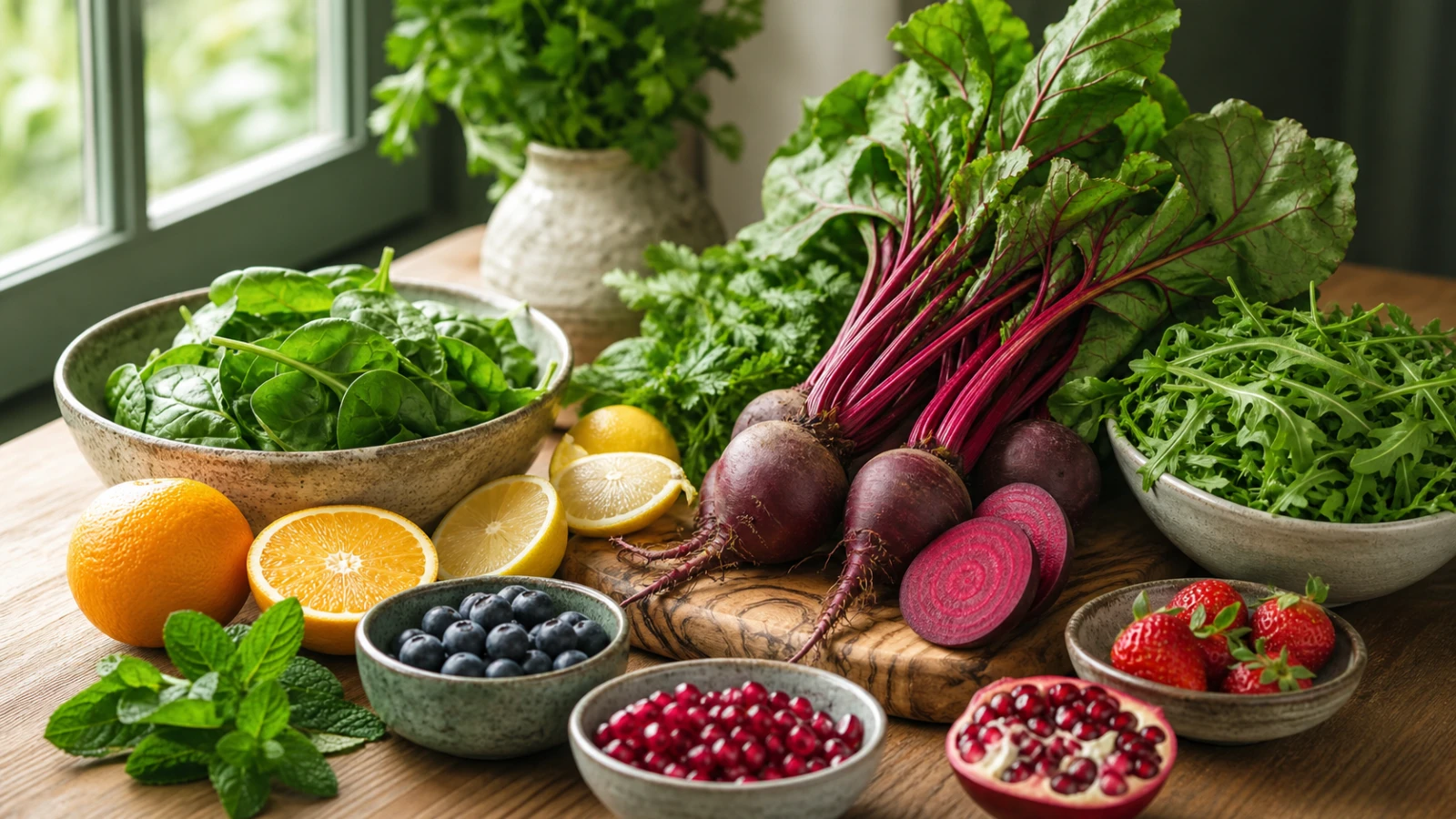
Leafy greens store the most nitrate (NO₃⁻). The body converts nitrate into NO via bacteria in the mouth and in the blood. The nitrate content of vegetables is confirmed by several independent sources.
| Vegetable | Nitrate (mg/kg) | How to eat it |
|---|---|---|
| Arugula (rocket) | 4,600 | highest; eaten fresh in salad |
| Spinach | 2,500 to 3,000 | sauteed or in a smoothie |
| Celery, cress | 1,000 to 2,500 | added to salad or fresh juice |
| Beets | 1,100 to 3,000 | juiced or roasted |
| Lettuce | 1,500 to 2,000 | as a salad base |
⚠️ caveat: nitrate content varies with how the vegetable is grown, the season, and storage. The figures above are representative values, not fixed numbers. Fresh vegetables provide more nitrate than vegetables stored for several days.
Some people drink about 70 to 140 milliliters of beet juice per day for around 2 weeks, with reports of modest blood-pressure reduction, although the blood-pressure effect from dietary nitrate is still less settled than the evidence for the vascular mechanism. Eating regular fresh vegetables usually takes consistent intake over a month before an effect may appear.
2. L-arginine (6 to 8 g per day) for People With Endothelial Decline
L-arginine is a direct precursor of NO. In healthy people, supplementing it does not clearly lower blood pressure, because the body already has enough. But in older people or those with chronic disease, the compound ADMA (asymmetric dimethylarginine) tends to build up and block the eNOS enzyme. Supplementing L-arginine may therefore help only in groups with:
- endothelial dysfunction
- diabetes with high ADMA
- peripheral arterial disease
A meta-analysis reports that L-arginine at 6 to 8 g per day lowers systolic pressure by about 5.39 to 6.40 mmHg and diastolic pressure by about 2.64 to 2.66 mmHg over 2 to 12 weeks.
⚠️ caveat: these blood-pressure figures for L-arginine are not yet confirmed by two independent sources, so treat them as preliminary rather than settled.
Absolute contraindication: L-arginine must not be used in people who have had a heart attack, because the VINTAGE MI trial published in JAMA in 2006 found that 6 patients in the L-arginine group died, compared with 0 in the control group.
3. L-citrulline (6 g per day): A Precursor That Absorbs Better
L-citrulline is a byproduct of the reaction that makes NO, and the body recycles it back into L-arginine. Its advantage is that it is not broken down by the liver on the first pass (first-pass metabolism), so it absorbs into the blood better than L-arginine. Its food source is watermelon, especially the white part of the rind near the flesh, and some beans.
It is reported that L-citrulline at 6 g per day lowers systolic pressure by about 4.02 to 4.10 mmHg and diastolic pressure by about 2.08 to 2.54 mmHg over a range of 1 week to 4 months, and improves FMD (flow-mediated dilation, a measure of vascular health) by about 0.9 percent in absolute terms.
⚠️ caveat: as with L-arginine, the blood-pressure figures for L-citrulline are not yet confirmed by two independent sources.
Points to Watch: Drug Interactions That Can Be Fatal
NO-boosting supplements carry more risk than vegetables because they can add to the effect of certain drugs until blood pressure drops dangerously.
Do not use L-arginine or L-citrulline together with these two drug groups:
- PDE5 inhibitors such as Viagra (sildenafil) and Cialis (tadalafil), because of the risk of a severe drop in blood pressure
- Nitrate drugs such as nitroglycerin used for chest pain, because of the risk that blood pressure drops until the brain lacks oxygen
NO supplements, PDE5 inhibitors, and nitrate drugs all raise NO or the effect of NO, so combined their effects add up and can be fatal.
Side Effects and Groups That Need Special Care
- Doses above 9 to 10 g per day: may cause gastrointestinal upset, diarrhea, and bloating
- People with latent HSV (herpes): L-arginine raises the arginine-to-lysine ratio that the herpes virus uses as fuel, which may trigger an outbreak on the mouth or lips. If such a person must use L-arginine, they should consult a doctor about antiviral medication alongside it.
Nitrosamine Risk: Vegetables and Processed Meat Differ
Nitrate and nitrite, in the presence of acid and amines such as in the stomach, can turn into nitrosamines, which are carcinogenic. This risk is high in processed meat that contains large amounts of curing salt, but low in natural fresh vegetables, because vegetables contain vitamin C and polyphenols that inhibit nitrosamine formation.
What Still Needs More Checking
The information below has preliminary references but is not yet confirmed by two independent sources, so treat it as an option that awaits more data.
- Cocoa flavanols at 500 to 1,000 mg per day are reported to activate eNOS and improve FMD.
- Watermelon or L-citrulline together with beet juice: mechanistically both raise NO precursors, but there is no trial comparing the combined formula.
Care for Your Vessels With Three Pillars
Nitric oxide is not the only answer; it is part of three pillars that maintain the endothelial cells:
- NO production: making enough NO via eNOS
- Endothelial-dependent vasodilation: the vessels widening when they receive an NO signal
- An antithrombotic state: healthy vessels keep platelets from clumping easily
NO governs all three, but durable change depends on consistency: eating high-nitrate vegetables, exercising, and avoiding risk factors such as smoking, pollution, and stress.
A Small Step You Can Take
If you want to keep your vessels flexible, start with the food that has the strongest evidence and is safest, which is high-nitrate leafy greens such as arugula, spinach, and beets in your regular meals. Treat supplements such as L-arginine or L-citrulline as an option only for groups with genuine endothelial decline, and always consult a doctor first, especially if you use PDE5 inhibitors, nitrate drugs, or have had a heart attack. This is caring with understanding, not following the ads.
This article is for understanding, not personal medical advice. Consult a doctor before starting supplements or changing medication, especially if you use a PDE5 inhibitor or nitrate drug

Read next
More in this category
Weight Management and Obesity: A Short Guide to Regain, Behaviors, and Looking Beyond BMI
A short guide to weight management and obesity, covering why weight regain is common at the population level and not a personal failure, why to look beyond BMI to waist and body composition, which sustainable behaviors are linked to long term maintenance, who should be careful, when to see a doctor, and how to start, treating every number as population level knowledge rather than a personal target.
Read article
BPPV Vertigo: What It Is, How It Is Diagnosed, and How to Manage It
A short guide to BPPV, benign paroxysmal positional vertigo, the most common cause of vertigo. It covers what BPPV is, why a head movement can make the room spin, what the symptoms look like, how it is diagnosed and managed with clinician guided repositioning maneuvers, and the warning signs that call for urgent care.
Read article
Cataracts: What They Are, How to Spot Them, and How They Are Treated
A short guide to cataracts, covering what a cataract is, how to spot the symptoms, what raises the risk, how it is diagnosed, and why surgery is the only proven treatment, decided together with an eye doctor.
Read articleVerifiable
References for this article
- 1 Nitric oxide signaling and cGMP/sGC vasodilation pathway - PubMed 26205960 pubmed.ncbi.nlm.nih.gov
- 2 Nitric oxide and the soluble guanylate cyclase pathway - PubMed 10567269 pubmed.ncbi.nlm.nih.gov
- 3 Endothelial nitric oxide and vascular function - PMC6728140 pmc.ncbi.nlm.nih.gov
- 4 Dietary nitrate content of vegetables - PubMed 19439460 pubmed.ncbi.nlm.nih.gov
- 5 Nitrate in leafy vegetables and dietary intake - PMC3575935 pmc.ncbi.nlm.nih.gov
- 6 Exercise training and endothelial function in type 2 diabetes (meta-analysis) - PubMed 29720185 pubmed.ncbi.nlm.nih.gov
- 7 Aerobic and resistance exercise and endothelial function in overweight and obesity - PubMed 37479727 pubmed.ncbi.nlm.nih.gov
- 8 Aerobic, resistance and combined training on endothelial function in older adults - PubMed 39621701 pubmed.ncbi.nlm.nih.gov
- 9 Resistance training and endothelial function (systematic review and meta-analysis) - PubMed 34399984 pubmed.ncbi.nlm.nih.gov
- 10 Exercise training and endothelium-derived nitric oxide function in humans - PubMed 15375191 pubmed.ncbi.nlm.nih.gov
- 11 Vascular nitric oxide and oxidative stress in endothelial adaptation - PubMed 16258183 pubmed.ncbi.nlm.nih.gov
- 12 Macro- and microvascular endothelial dysfunction in diabetes - PubMed 28044409 pubmed.ncbi.nlm.nih.gov
- 13 Aerobic exercise and inflammatory markers (systematic review and meta-analysis) - PubMed 31080412 pubmed.ncbi.nlm.nih.gov
- 14 Regular exercise and insulin sensitivity in type 2 diabetes - PubMed 27535644 pubmed.ncbi.nlm.nih.gov
- 15 Physical activity and stroke risk (meta-analysis) - PubMed 14500932 pubmed.ncbi.nlm.nih.gov
- 16 Physical activity level and stroke outcomes - PubMed 20929415 pubmed.ncbi.nlm.nih.gov
- 17 WHO 2020 guidelines on physical activity and sedentary behaviour - PubMed 33239350 pubmed.ncbi.nlm.nih.gov
Reviewed by Health Coach: A888