
Diverticular Disease: What It Is, How It Differs From Inflammation, and How to Manage It
A short guide to diverticular disease, covering how simply having pouches (diverticulosis) differs from having an inflamed pouch (diverticulitis), what raises the risk, how it is diagnosed, how it is managed under a doctor's care, and why the old advice to avoid nuts and seeds is no longer recommended.

Last updated 2026-09-03 ⇒ reviewed against the 2026 ACG guideline
What You May Be Dealing With
Maybe you had a routine colonoscopy and your doctor mentioned small pouches in the wall of your colon. Or maybe pain came on suddenly in your lower left abdomen, along with a fever, and you heard the word diverticulitis. Two similar words, diverticulosis and diverticulitis, sound alike but mean very different things. The reassuring news first: having pouches in the colon is very common with age, and for most people it is not something to worry about.
Having Pouches Versus Inflammation
Diverticula are small pouches that bulge out from the wall of the colon, and diverticulosis simply means having these pouches. It becomes more common with age, and most people who have pouches never have any symptoms. Many only find out during a colonoscopy done for another reason. So having pouches on its own is usually not a disease in itself.
Things change when a pouch becomes inflamed or infected, which is called diverticulitis. It causes abdominal pain, typically in the lower left, along with a fever and a change in bowel habits. In severe cases it can lead to complications such as an abscess, a perforation, or bleeding. But among the many people who have pouches, only a minority ever develop inflammation.
What Raises the Risk, and How It Is Diagnosed
Factors associated with this condition include a low fiber diet, increasing age, being overweight, physical inactivity, and smoking, all of which are associations rather than fixed verdicts. As for diagnosis, pouches without symptoms are often found by chance during a colonoscopy, while actively inflamed diverticulitis is usually diagnosed during an episode, often with a CT scan. That is why it should be diagnosed by a doctor, not concluded from abdominal pain alone.
How It Is Managed
The 2015 AGA guideline notes that many cases without complications and with milder symptoms can be managed conservatively, and that antibiotics are not used in every case but selectively, case by case, based on a doctor’s assessment. In cases with complications such as an abscess or a perforation, drainage or surgery may be needed. These decisions are entirely for a doctor to make. For longer term care, the core is eating a high fiber diet, drinking enough fluids, staying active, and keeping your weight in a healthy range. The current guideline is the 2026 ACG guideline, which supersedes the 2015 AGA guideline and states this more firmly. It also changes two things: it recommends a colonoscopy after recovery from complicated diverticulitis, allowing roughly six to eight weeks for the inflammation to settle, and it no longer uses the number of recurrences as the trigger for surgery, looking instead at how much the symptoms affect your quality of life, decided with your doctor case by case.
One thing worth knowing: the old advice to strictly avoid nuts, seeds, and popcorn to prevent diverticulitis is not supported by evidence and is no longer recommended, so you do not need to fear these foods.
When to See a Doctor Quickly
Get to a doctor or an emergency department without waiting if you have severe abdominal pain, especially in the lower left, a fever along with abdominal pain, an inability to pass stool or unusual bloating, or signs of bleeding such as blood in the stool. These are situations that need urgent care, so do not wait it out at home.
Start Today, One Step First
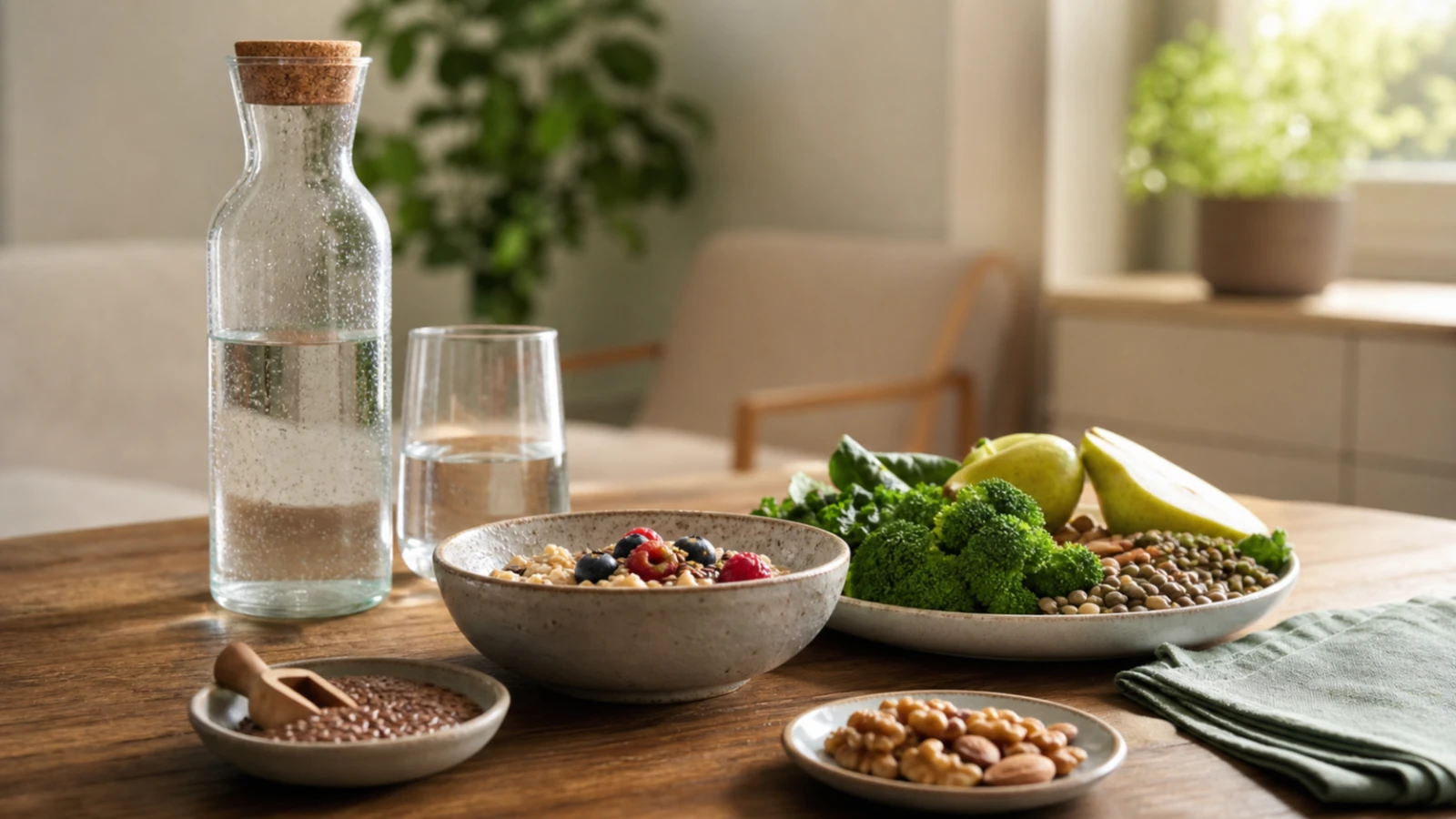
Gradually add more fiber to your meals, going slowly, alongside drinking enough fluids so the bowel can adjust. Try to stay active with regular movement, keep your weight in a healthy range, and do not fear nuts or seeds the way people once believed you should. If you have severe abdominal pain or a fever, see a doctor, do not wait.
This content is general information for health care, not advice that replaces seeing a doctor. Diagnosing and managing diverticular disease should always be done together with a doctor.
This summary is for understanding, not medical advice, and should be reviewed by a professional before being applied in real life. The full version includes complete reasoning and research.

Summary complete
This was the key-points summary
Want to understand why, and the research behind it? Read the full version.
Read the full reasoning and researchRead next
More in this category

Dietary Fiber, the Gut, and Metabolic Health: A Short Guide to LDL, Post-Meal Glucose, Microbes, and Fullness
A short guide to dietary fiber, the gut, and metabolic health, covering how soluble and viscous fiber is linked to lower LDL cholesterol, gentler post-meal glucose, short-chain fatty acids from gut microbes, and greater fullness, with the population-level effect sizes, the limits, who should be careful, and how to start adding fiber gradually with water, while treating every number as guidance to adjust with a doctor or dietitian.
Read article
Caffeine and Health: What It Is, How Much Is Reasonable, and Who Should Be Careful
A short guide to caffeine and health, covering how caffeine works, where it hides, the amount often cited as reasonable for most healthy adults, why too much or too late disrupts sleep and causes jitteriness, who should have less or none, and how to start looking after yourself, while treating every number as guidance a doctor tailors to you.
Read article
Celiac Disease: What It Is, How It Is Diagnosed, Why You Must Be Tested Before Quitting Gluten, and How to Manage It
A short guide to celiac disease, covering what it is, what gluten does to the small intestine, how wide the symptoms can be, how it is diagnosed, why testing must happen while you are still eating gluten, and how to start looking after yourself.
Read articleVerifiable
References for this article
- 1 ACG Clinical Guideline: Colonic Diverticulitis (Am J Gastroenterol 2026;121(7), DOI 10.14309/ajg.0000000000004047) journals.lww.com
- 2 Superseded (kept for comparison) Stollman N et al. AGA Institute Guideline on the Management of Acute Diverticulitis (Gastroenterology 2015, PMID 26453777) pubmed.ncbi.nlm.nih.gov
- 3 StatPearls (NCBI Bookshelf NBK430771): Diverticulosis ncbi.nlm.nih.gov
- 4 NIDDK (NIH): Diverticular Disease niddk.nih.gov
Reviewed by Health Coach: A888