
Creatine: Benefits Beyond Muscle, and the Truth About Kidneys and Hair Loss
Creatine monohydrate at 3 to 5 grams per day increases strength and muscle mass when you lift, is safe for people with healthy kidneys, and does not cause the hair loss people fear. Brain effects are real but small and clear only in specific situations
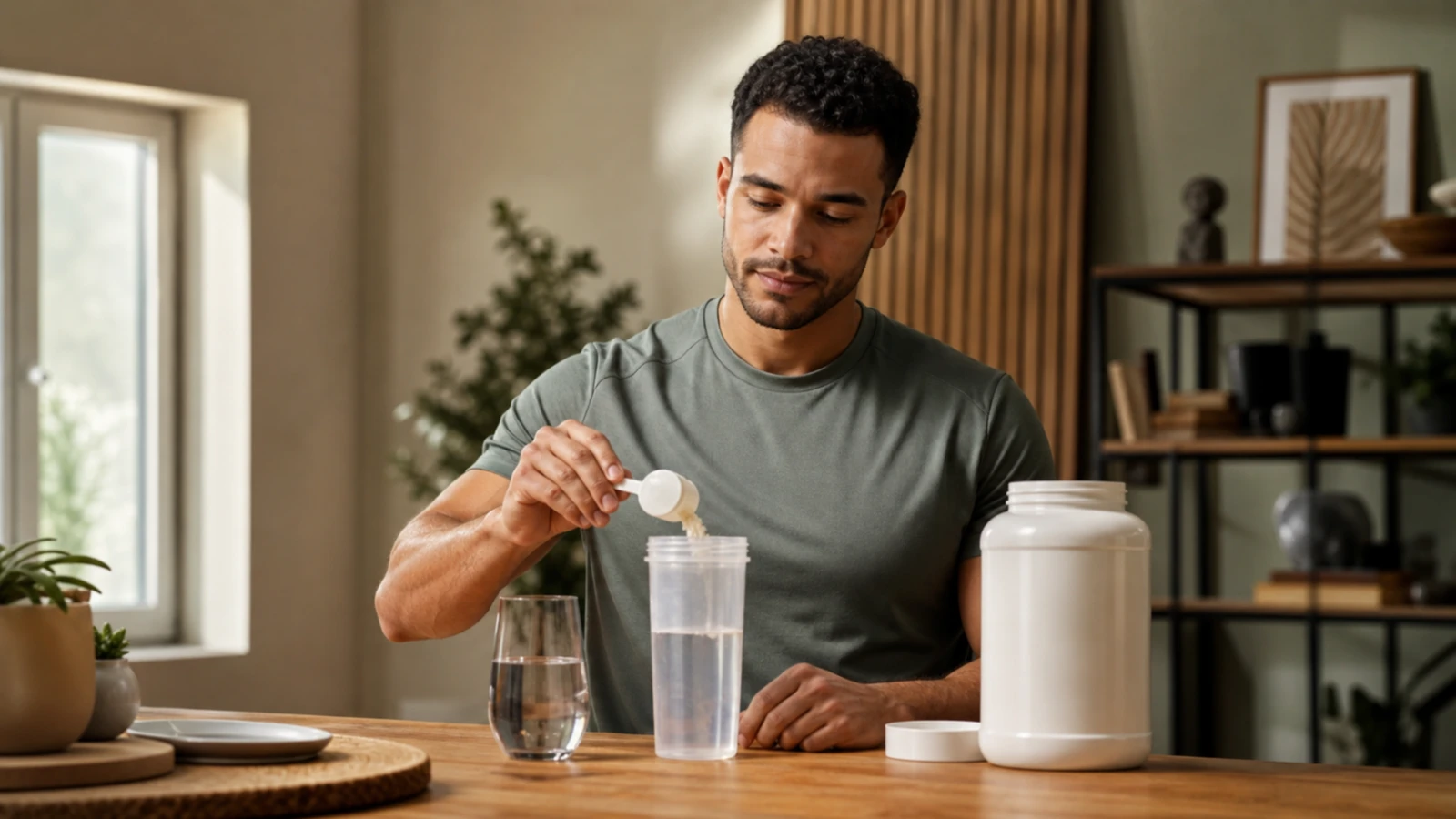
Creatine is a supplement that people who lift weights know well, but lately more people are talking about its effects on the brain, bones, and older adults. At the same time, many still fear that it damages the kidneys and causes hair loss. Which of these is backed by evidence, and which is an unsupported fear?
Creatine is a substance the body makes on its own and that is also found in meat. It stores reserve energy for cells that burn energy quickly, both in muscle and in the brain. Supplementing means topping up this reserve. This article summarizes where the evidence is strong and where it is weaker, for anyone who wants to understand before deciding to use it.
Three-Line Summary
- Creatine monohydrate at 3 to 5 grams per day increases strength and muscle mass when you lift weights. It is one of the best-studied and safest supplements available.
- Brain effects are real but small and inconsistent. They are clearest during sleep deprivation and in people who eat a vegetarian diet, while using it as an antidepressant adjunct in women has good-quality evidence.
- The belief that creatine damages the kidneys and causes hair loss is not supported by the evidence.
Muscle, Strength, and Basic Safety
The position of the International Society of Sports Nutrition (ISSN), drawing on a large body of work, is that creatine monohydrate is the most effective supplement for performance and muscle mass. There are two ways to take it, and both reach the same end result.
| Method | Dose | Result |
|---|---|---|
| Loading (not required) | 20 to 25 grams per day split into 4 doses for 5 to 7 days, then drop to 3 to 5 grams | Saturation in 5 to 7 days |
| Gradual | 3 to 5 grams per day from the start | Saturation in about 4 weeks, less stomach upset |
On safety, the ISSN position states that both short-term and long-term use, up to 30 grams per day for 5 years, is safe in healthy people from children to older adults. The only consistently observed side effect is a small weight gain from water entering the muscle cells.
Brain, Sleep Deprivation, and Depression
The effect on thinking and memory in generally healthy people is still small and inconsistent. A 2024 meta-analysis (16 trials, n=492) found a moderate effect on memory but no effect on executive function, and the European Food Safety Authority in 2024 judged the evidence that creatine helps the brain in healthy people to be weak.
The point where the evidence is strongest is during sleep deprivation. A 2024 study gave a single dose of creatine during sleep deprivation and found processing speed improved by 24 to 29 percent compared with placebo. What is interesting is that the effect came from a single dose, which suggests that metabolic stress may open a path for creatine to enter the brain faster.
On depression, a 2012 study gave 52 women with depression 5 grams of creatine per day together with escitalopram and found depression scores improving from week 2, along with matching changes in brain markers. ⚠️ Caveat: this study was done in women only, so it is not yet known whether men respond the same way.
Older Adults, Bones, and Women
In older adults, a meta-analysis of 8 trials with an average age of about 65 found that creatine plus resistance training increased lean muscle mass more than resistance training alone, by about 1.4 kilograms. The key point is that you have to train alongside it. Creatine on its own in older adults who do not exercise has almost no effect.
On bones, a study in postmenopausal women who took creatine together with exercise for 2 years found improved femoral neck bone structure, but bone density did not increase, and density is the more important outcome, so a reduction in fractures cannot yet be concluded.
⚠️ Caveat: women are the group where research is still lacking. Creatine supplementation studies in postmenopausal women are only small, and there is almost no work at all in the perimenopausal stage.
What to Watch For: Beliefs the Evidence Does Not Support
“Creatine damages the kidneys”
More than 25 review articles in healthy people found no decline in kidney function. The rise in blood creatinine after starting reflects greater creatine turnover, not kidney injury, and the glomerular filtration rate does not change. ⚠️ But people who already have kidney disease should consult a doctor first, because this work was done in people with healthy kidneys.
“Creatine causes hair loss”
This belief comes from a single 2009 study in 20 rugby players that found increased DHT hormone, but that study did not measure hair loss at all, only the hormone, and no one has ever been able to replicate it. The 2021 review concluded there is no change in testosterone or DHT. The leap from DHT to hair loss has no evidence behind it.
“Creatine causes cramps and dehydration”
Many review articles found no evidence that creatine increases cramps or disrupts temperature regulation. The mechanism is that creatine pulls water into the muscle cells rather than pulling water out of the body, but you should still drink enough water as usual.
A Small Step You Can Take
If you already lift weights and want to preserve muscle at an age when it is easily lost, creatine monohydrate at 3 to 5 grams per day is the option with the most evidence and the lowest cost. You can take it at any time of day, with no need to load, and remember that creatine works alongside exercise, not in place of it. As for fancy, expensive forms such as HCl or buffered creatine, there is still no evidence that they are better than the monohydrate that has 25 years of confirming research.
Read next
More in this category

Dietary Fiber, the Gut, and Metabolic Health: A Short Guide to LDL, Post-Meal Glucose, Microbes, and Fullness
A short guide to dietary fiber, the gut, and metabolic health, covering how soluble and viscous fiber is linked to lower LDL cholesterol, gentler post-meal glucose, short-chain fatty acids from gut microbes, and greater fullness, with the population-level effect sizes, the limits, who should be careful, and how to start adding fiber gradually with water, while treating every number as guidance to adjust with a doctor or dietitian.
Read article
Caffeine and Health: What It Is, How Much Is Reasonable, and Who Should Be Careful
A short guide to caffeine and health, covering how caffeine works, where it hides, the amount often cited as reasonable for most healthy adults, why too much or too late disrupts sleep and causes jitteriness, who should have less or none, and how to start looking after yourself, while treating every number as guidance a doctor tailors to you.
Read article
Celiac Disease: What It Is, How It Is Diagnosed, Why You Must Be Tested Before Quitting Gluten, and How to Manage It
A short guide to celiac disease, covering what it is, what gluten does to the small intestine, how wide the symptoms can be, how it is diagnosed, why testing must happen while you are still eating gluten, and how to start looking after yourself.
Read articleVerifiable
References for this article
- 1 ISSN position stand on creatine - Kreider et al., J Int Soc Sports Nutr (2017, PMID 28615996) pubmed.ncbi.nlm.nih.gov
- 2 Common questions & misconceptions about creatine supplementation (review) - Antonio et al., J Int Soc Sports Nutr (2021, PMID 33557850) pubmed.ncbi.nlm.nih.gov
- 3 Creatine and cognition during sleep deprivation - Scientific Reports (2024, PMID 38418482) pubmed.ncbi.nlm.nih.gov
- 4 Creatine as adjunct in depression - Lyoo et al. (2012, PMID 22864465) pubmed.ncbi.nlm.nih.gov
Reviewed by Health Coach: A888