
Alcohol After 40: A Short Evidence Summary Before Believing Light Drinking Is Healthy
A short 40+ evidence summary on what alcohol research says about cancer, cardiovascular disease, and all-cause mortality, with clear caveats
The Situation You Might Actually Face
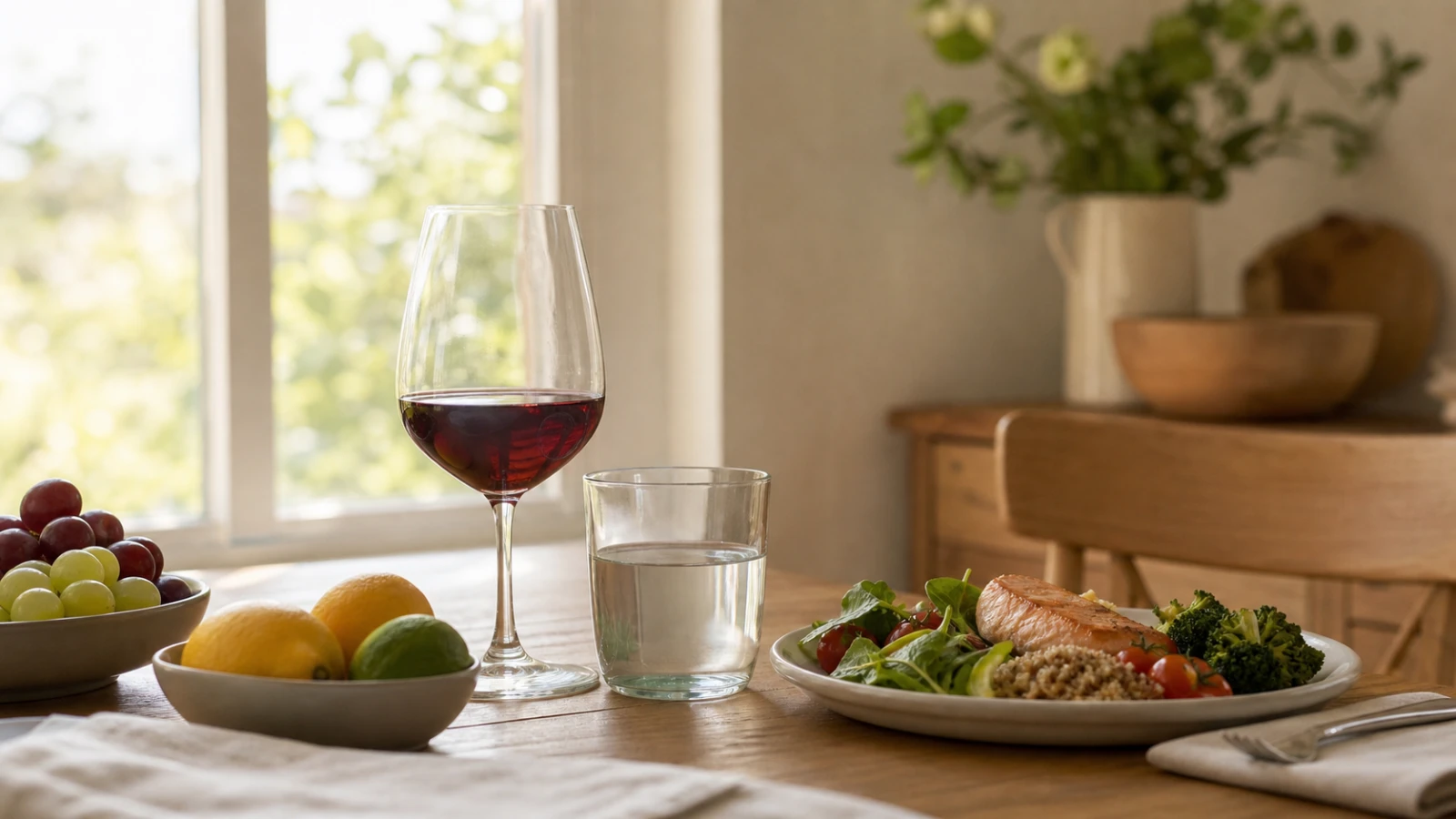
Picture a dinner one evening. Someone hands you a glass and says, “It is just a little, and it is good for the heart anyway.” You may not even want to get drunk. You just want to relax, be sociable, or not seem rude by refusing.
Past 40, a line like that starts to carry more weight, because you are no longer thinking only about tonight. You are thinking about your blood pressure, your heart, cancer, the medication you take, and the people at home you still want to look after for a long time.
So the real question is not “will this get me drunk.” It is “am I drinking because I actually believe it is good for my health.”
What We Used to Believe, and What the Evidence Says
The old belief was that a little alcohol might help the heart, like a small tonic after a meal. This evidence bundle makes that picture a lot weaker.
Here is a simpler way to see it. Alcohol is not like vegetables, not like a walk, not like a full night’s sleep. You should not drop it into the same basket as the things you do for your health.
On cancer, the evidence is direct: for preventing cancer, this bundle finds no safe drinking threshold anyone can identify, and the risk of several cancers rises even at low intake.
On the heart, the evidence that uses genetic data to strip out confounders does not support the belief that alcohol is a tool for protecting the heart.
On living longer, the pooled research finds that once you correct for a big bias, low-level drinking does not meaningfully lower death from any cause compared with people who never drank in their lives.
Three-Line Summary
- For preventing cancer, this bundle finds no safe drinking threshold anyone can identify.
- The evidence that uses genetic data to cut down confounders does not support the belief that alcohol protects the heart.
- The long-term Thai data tied steady, ongoing drinking to higher all-cause and cancer deaths, though the evidence for cardiovascular-specific death stayed uncertain.
The Main Findings From the Research
| Topic | What to know | Evidence level |
|---|---|---|
| Cancer | The risk of cancer of the esophagus, colon and rectum, and breast rises even at low intake | Strong |
| Cardiovascular disease | Habitual drinking is tied to higher risk, including high blood pressure and coronary artery disease | Strong |
| Death from any cause | Low-level drinking does not meaningfully lower death compared with never drinking, once selection bias is corrected | Strong |
| Thai data | Steady, ongoing drinking is tied to higher all-cause and cancer deaths | Moderate to strong |
The thing to get right is this. The studies that once made light drinkers look healthier may have compared the wrong groups. It is like filing someone who drank heavily and then quit because their health changed into the same group as people who never drank at all. The “non-drinker” group ends up looking less healthy than it really is, which makes light drinking look better than the evidence supports.
Where You Still Have to Read Carefully
⚠️ The Thai data are valuable because they followed Thai adults for 30 years. But the bundle states that the statistical evidence for a direct link to cardiovascular-specific death stayed weak and uncertain.
⚠️ This article does not give you a drinking amount that fits everyone, and it is not personal treatment advice. If you have cardiovascular disease, high blood pressure, cancer, kidney disease, or you take medication regularly, talk with a doctor before you make decisions from general information.
Putting This to Use in Real Life
What you can do right now is not blame yourself. It is to line up the reason in your head more honestly.
If you are going to drink, do not use “good for the heart” as your health reason, because this bundle does not support that picture.
If you have a family history of cancer, a past cancer, cardiovascular disease, high blood pressure, kidney disease, or you take medication regularly, talk your own risk over with a doctor or a professional who knows your history, rather than deciding from something said over dinner.
Start Tomorrow, One Step First
Tomorrow, before you take the glass, pause for ten seconds and ask yourself: is this glass really for my health, or just a habit? If the answer is health, treat this evidence as having closed that door already.
The small step is to stop letting the old myth lead, and to take your own real risk to the person who looks after your health.
This summary is for understanding, not medical advice, and should be reviewed by a qualified professional before being applied in practice. The full version contains the complete rationale and research

Summary complete
This was the key-points summary
Want to understand why, and the research behind it? Read the full version.
Read the full reasoning and researchRead next
More in this category

Asthma: What It Feels Like, How It Is Diagnosed, and How to Manage It Safely
A short guide to asthma as chronic airway inflammation, with key symptoms such as wheeze, night cough, chest tightness, and breathlessness; diagnosis with clinical assessment and spirometry; modern controller treatment principles; inhaler technique; written action plans; trigger reduction; and emergency warning signs.
Read article
Parkinson's Disease: What It Is, How to Recognize It, and How It Is Managed
A short guide to Parkinson's disease: how dopamine-related neurodegeneration can cause resting tremor, slowness, stiffness, balance problems, and non-motor symptoms such as constipation, sleep behavior changes, loss of smell, and depression, plus when to see a doctor and how treatment and lifestyle care fit together.
Read article
Long COVID: A Short Guide to Fatigue, Brain Fog, Palpitations, and Pacing
A short guide to Long COVID, or PASC, covering what the research finds, common symptoms such as fatigue, brain fog, and palpitations on standing, why pushing through exercise may make people with post-exertional malaise (PEM) worse, the pacing approach studied to manage symptoms, and the warning signs that need a doctor, all as health education rather than a diagnosis, with no promise of a cure.
Read articleVerifiable
References for this article
- 1 Health and cancer risks associated with low levels of alcohol consumption - WHO Collaborating Group, The Lancet Public Health (2023, PMID 36603913) pubmed.ncbi.nlm.nih.gov
- 2 Association Between Daily Alcohol Intake and Risk of All-Cause Mortality: A Systematic Review and Meta-analyses - Zhao et al., JAMA Network Open (2023, PMID 37000449) pubmed.ncbi.nlm.nih.gov
- 3 Association of Habitual Alcohol Intake With Risk of Cardiovascular Disease - Biddinger et al., JAMA Network Open (2022, PMID 35333364) pubmed.ncbi.nlm.nih.gov
- 4 Cancer risk based on alcohol consumption levels: a comprehensive systematic review and meta-analysis - Jun et al., Epidemiology and Health (2023, PMID 37905315) pubmed.ncbi.nlm.nih.gov
- 5 Associations between alcohol consumption trajectory and deaths due to cancer, cardiovascular diseases and all-cause mortality: a 30-year follow-up cohort study in Thailand - Jankhotkaew et al., BMJ Open (2020, PMID 33361071) pubmed.ncbi.nlm.nih.gov
Reviewed by Health Coach: A888